
Searching for a Miami-Dade property sounds simple until you hit the first fork in the road. Is the owner, value and square footage on one website, the tax bill on another, and the deed and mortgage on a third? Yes, and that’s the main reason people get stuck. This guide explains which county office holds which record, how to search by address, owner name or folio number, and what to do when a search returns nothing, using the county’s own search help and real questions people ask in property and legal forums.
This article is general information, not legal, tax or real estate advice. Public records can contain errors or lag behind recent sales, so confirm anything important with the county office or a licensed professional.
Where to Start: The Official Miami-Dade Property Search
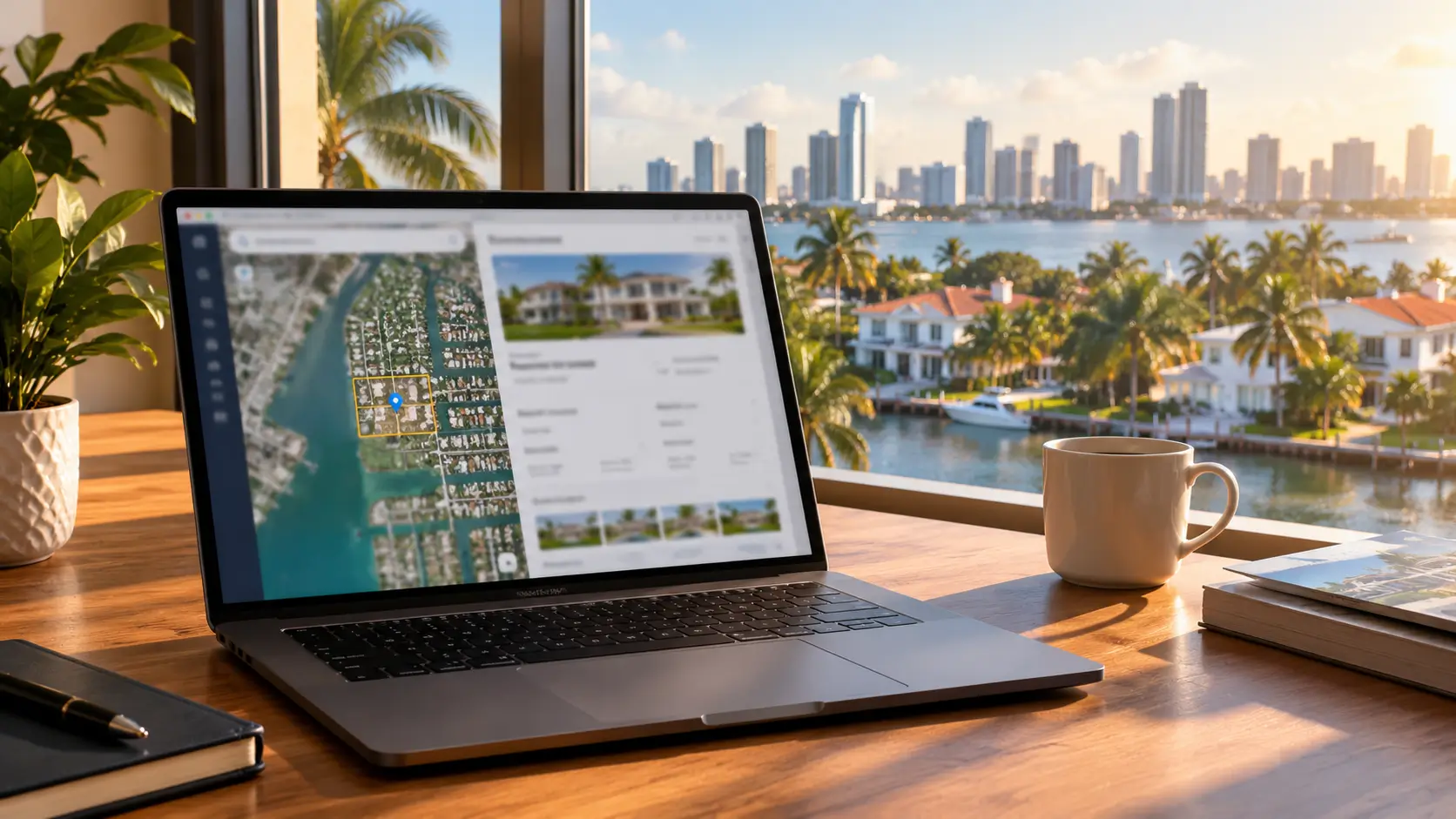
The official tool is the Property Search application run by the Miami-Dade County Property Appraiser (miamidadepa.gov). It lets you search by address, owner name, folio number, or subdivision name, and it shows key property characteristics, ownership, and sales history.
It is free. Plenty of unofficial sites repackage the same public data, and some of them charge for it, so start at the county’s own site and only go elsewhere if you need something it doesn’t offer.
Which Office Holds Which Record?
This is the part most guides skip, and it’s the source of most “I can’t find it” frustration. Three county offices handle three different kinds of information:
| What you need | Where to look | What you’ll find |
|---|---|---|
| Owner, value, exemptions, square footage, sales history | Property Appraiser property search | Assessment and property characteristics |
| Tax bill, payment status, paying online | Tax Collector (mdctaxcollector.gov) | Bills and payments |
| Deeds, mortgages, liens, recorded documents | Clerk of Courts official records | Legal and title documents |
A simple way to remember it: the Appraiser decides what the property is worth, the Tax Collector collects the money, and the Clerk keeps the legal paperwork. The Appraiser’s own search page states that its data is for ad valorem (property tax) assessment purposes only. That wording matters. It means the site is not a title search, and it won’t show you everything recorded against a property.
How to Search by Address
Address search is the most intuitive option for most people. Type the house number and street exactly the way Miami-Dade writes it, for example 111 NW 1 St or 5680 SW 87 Ave.
Tips from the county’s search help:
- Use the county’s street format. Miami-Dade uses a grid system, so streets often look like “SW 87 Ave” rather than a named street.
- Don’t know the house number? Search by street name or an intersection instead, such as “Alhambra Cir” or “Bird Rd and 87 Ave,” and browse the results on the map.
- If an exact match fails, try dropping directional terms or abbreviations and search again.
One Reddit user in a real estate thread also noted that the address shown on county records can differ from the one used by a city or in a listing, which brings up a related point: always cross-check with the folio number (below) if the address search seems to point at the wrong place.
How to Search by Owner Name
Owner name search works for individuals, companies and trusts. According to the county’s help page, a basic name search is done with first name followed by last name, for example “John Smith” or “Jose Rodriguez.”
If you get no results:
- Try the last name alone. A full name that doesn’t match exactly can return nothing, while the surname by itself will list everything.
- Names starting with “Mc” or “Mac” are written as one word, so search “McDonalds” rather than “Mc Donalds.”
- Hyphenated names can be entered with or without the hyphen.
- Numbers and special characters that appear in some owner names can be entered too.
A search results list can include several properties. In one tax-help thread, an expert answering a landlord’s question explained that searching by owner name will list every property held under that name, including a trust, and you can then click each one to see its tax bill and the amount paid.
When the Owner Is an LLC or a Trust
Property owned by a company rarely shows a person’s name. A commenter in a commercial real estate forum described the usual route: look up the address or folio first, then check the owner listed. When the owner is an LLC, a legal-help forum answer pointed out that the next step is the state’s business entity search, where the LLC’s registered details are listed. The county property record alone often won’t tell you who is behind the company.
How to Search by Folio Number
A folio number is the property’s unique 13-digit identification number. It’s the most precise way to pull up one specific parcel, because two addresses can look alike but no two folios do.
Use folio search when:
- You already have a number from a tax bill, TRIM notice or closing paperwork
- The address search returns the wrong parcel or several parcels
- You’re comparing properties and want to avoid mix-ups
Your folio number is also the key that connects the three offices. The same number works across the Appraiser’s record, your tax bill, and the recorded documents for the property.
Searching by Subdivision, Map and Condo Unit
The property search also has a map view with aerial imagery and parcel boundaries. For condominiums, the county’s help says you can double-click a condo complex on the interactive map to see a full list of the individual unit owners, which is faster than guessing unit numbers one at a time.
What You’ll See on a Property Record
Once you open a record, the Appraiser’s page generally shows:
- Owner of record and mailing information
- Sales history with recorded transaction details
- Values: market value, assessed value and taxable value
- Exemptions, such as homestead, senior or veteran, where they apply
- Building details: adjusted square footage, year built, lot size and land use
- Sketches and aerial imagery where available
The difference between the three value types trips up a lot of buyers. In short, market value is what the Appraiser estimates the property would sell for, assessed value is the figure after assessment limits are applied, and taxable value is what’s left after exemptions. The taxable value is the number your tax bill is calculated from.
When the Record Doesn’t Match Reality
Public records can be wrong, and homeowners run into this regularly. In a real estate forum thread, someone described a house that is actually 4 bedrooms and 3 baths while the public record showed 3 and 2. If you spot an error like that, the Appraiser’s office can be contacted directly to correct property details, and the home page of the site lists an option to amend owner name, address and similar information.
Miami-Dade Property Tax Search: Checking and Paying Taxes
For taxes, the Appraiser’s site is not where you pay. Use the Tax Collector’s website to look up and pay a bill, usually searching by folio number or owner name. The Appraiser’s site does offer a Property Tax Estimator, which calculates estimated annual taxes from current assessment data. That’s useful when you’re comparing homes before buying.
A few real-world points from forums:
- Online payment glitches happen. Users on r/Miami have posted about getting stuck partway through paying on the county tax site, including trouble with e-check payments. If a payment won’t process, phone the Tax Collector’s office rather than retrying repeatedly.
- Tax bills for rentals: a legal-help answer to a landlord looking for missing records suggested creating an online account on the Tax Collector’s site and using the property details to pull up payment history.
- Is your bill “normal”? One Reddit user asked whether paying nearly 5% of purchase price in annual property taxes was normal. The top reply said no, and that it’s generally closer to about 2% of purchase price, usually less with a homestead exemption. That’s a forum answer, not a rule, but it shows why it’s worth checking your taxable value and exemptions against the property record.
Homestead Exemption
If the property is your primary residence, the exemption is applied through the Property Appraiser, and an exemptions line exists at the office. A Florida legal-advice answer noted that applications are typically filed with the Property Appraiser by March 1 of the tax year, and that a Florida driver’s license or voter registration showing the property address helps support the claim. Another homeowner discussion noted that once you have the homestead exemption in Florida, you generally don’t have to reapply each year, though you should check your own record annually to confirm it still shows.
Deeds, Mortgages and Liens: Use the Clerk’s Official Records
If you need a recorded deed, mortgage or lien, the property search won’t give you the document itself. That’s the Miami-Dade Clerk of Courts official records system. Several questions in legal forums revolve around this split:
- Getting a copy of a deed. People looking for their own deed or a relative’s property are generally pointed to the Clerk’s records rather than the Appraiser.
- Checking a deceased relative’s property. A legal answer for someone trying to locate a deceased family member’s property explained that public records show the recorded owner name, using the person’s legal name as it appears on official records, and pointed to the county’s property search as the starting point.
- Duplicate recordings. An attorney answering a question about four copies of the same deed on public record explained that multiple copies can exist for several ordinary reasons, such as multiple grantors signing separate deeds.
If you’re buying, a recorded-document search shows what’s been filed, but a title search by a title company is the proper way to confirm ownership before closing. As one Quora answer put it, tax records show the registered owner, but a title search should be done before any deal is completed.
Use Comparable Sales to Value a Property
The Appraiser’s site includes a Comparable Sales tool that lets you look up recent sales by address or folio in a neighborhood. A Reddit commenter described it as surprisingly useful because you can see recorded details such as condition, upgrades and photos, which is helpful for estimating what a nearby home might be worth. Because it’s built on recorded data, it won’t capture a sale that closed very recently, so check how current the entries are.
Protect Yourself: Property Fraud Alerts
Because property records are public, they can be misused. An estate-planning answer on a legal Q&A site noted that Miami-Dade and Palm Beach counties offer free property fraud alert services that notify you by email or text whenever a document is recorded against your property. If you own property, particularly property you don’t live in, signing up costs nothing and gives you early warning if someone files something unexpectedly.
Miami-Dade Property Search Contact Numbers and Office Details
Phone lists change, and the Appraiser’s contact page shows different numbers for different departments. Based on the county’s published pages:
- Property Appraiser: 111 NW 1st Street, Miami, FL 33128. The homepage lists 305-375-4712 for scheduling appointments. The contact page lists separate lines for public service, exemptions, real estate, and agriculture, so check it for the department you need.
- Tax Collector: 305-375-5448, with email at support@mdctaxcollector.gov. Weekday hours are listed as 8:00 AM to 5:00 PM, and Saturday hours are also published on their site.
- General county information: dial 311, or 305-468-5900 from outside the county.
Always confirm numbers on the official contact pages before calling, since departments reorganize lines.
Official Site vs. Third-Party Property Sites
Search results for “Miami Dade property search” include the official Appraiser pages plus a number of unofficial sites that wrap the same public data in their own design. Some offer free lookups, while others sell reports. A search overview noted that going directly to the official portal helps you avoid third-party sites that charge for public records. If a site asks for payment to view a basic property record, check whether the same information is free on the county’s page first.
Quick Troubleshooting: When Your Search Returns Nothing
- Check the format. Use first name then last name for owners, and the county’s grid format for addresses.
- Search by surname only, or by street only, and narrow from there.
- Try the folio number if you have one from a bill or notice.
- Look in the right office. If you need a deed, lien or mortgage, use the Clerk’s official records instead.
- Remember recent sales may lag. A property that sold in the last few weeks may still show the previous owner.
- Call the office. The Appraiser’s public service line can help locate a parcel.
Frequently Asked Questions
How do I search for a property in Miami-Dade County?
Use the Miami-Dade County Property Appraiser’s Property Search, where you can search by address, owner name, folio number or subdivision name. The search is free.
How do I find the owner of a property in Miami-Dade?
Search the address or folio number in the Property Appraiser’s tool and read the owner of record. You can also search by owner name, using first name then last name, to find properties under a given name. For company-owned property, you may need the state business entity search to learn who is behind an LLC.
What is a folio number?
A folio number is the unique 13-digit parcel identification number for a property in Miami-Dade County. It’s the most precise search key and works across the Appraiser, Tax Collector and recorded documents.
Where do I pay Miami-Dade property taxes?
Through the Miami-Dade Tax Collector, not the Property Appraiser. The Appraiser’s site shows values and estimates, while the Tax Collector handles bills and payments.
Can I see deeds and mortgages on the property search?
Not the documents themselves. Recorded deeds, mortgages and liens are in the Miami-Dade Clerk of Courts official records.
What if the property record is wrong?
Contact the Property Appraiser’s office. Owner name, address and certain property details can be reviewed and amended through the office.
About the Author

Andy Abramson writes about luxury real estate, waterfront communities and high-end lifestyle destinations. Her articles focus on explaining what makes exclusive places distinct, and she checks facts against official sources, public records and major news outlets. You can reach Andy at andyabramsonn@gmail.com.
More from Insight Bullion