
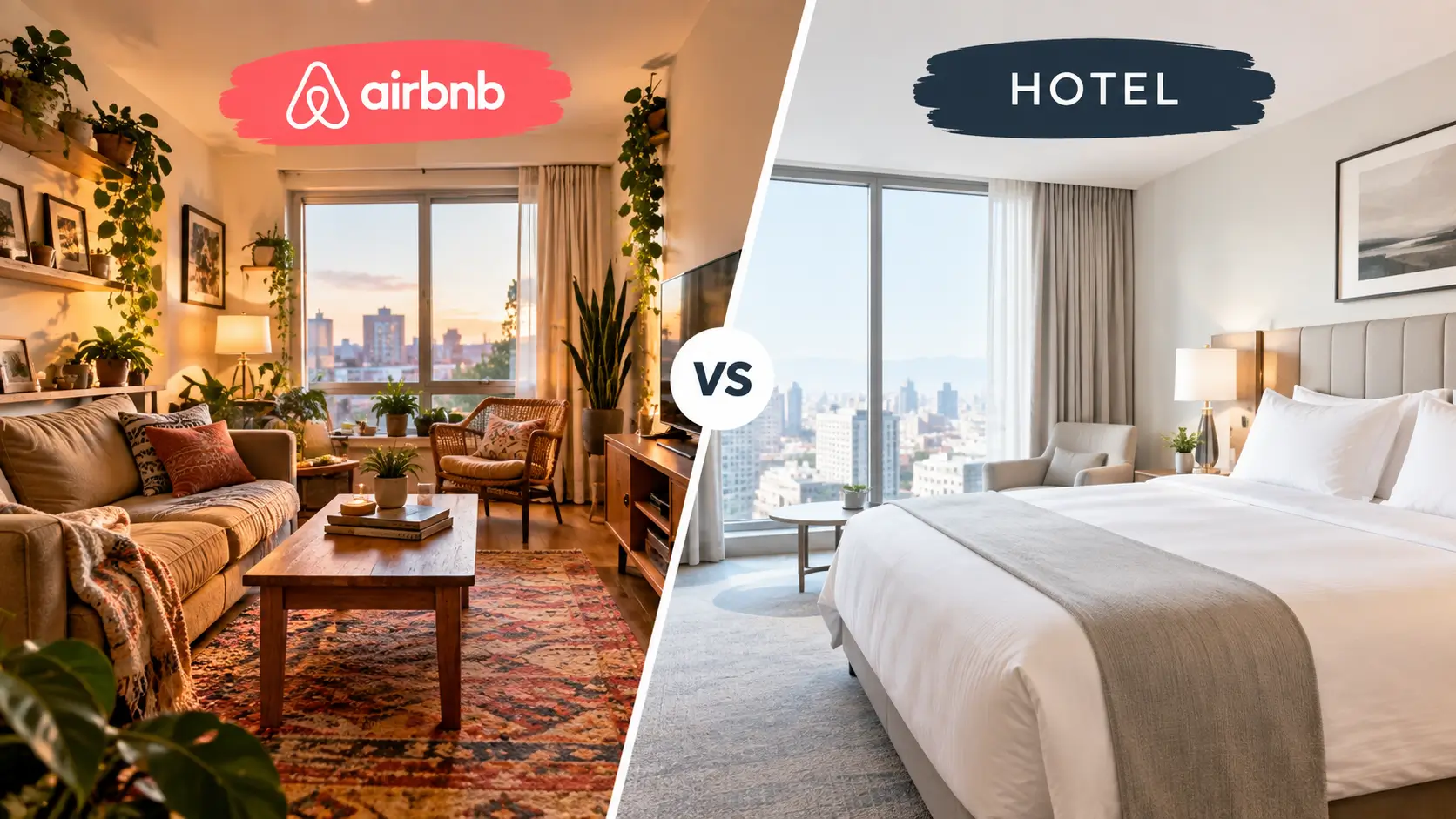
The Airbnb-versus-hotel debate used to have an easy answer: Airbnb was cheaper, hotels were safer, pick your priority. That math doesn’t hold anymore. Cleaning fees, service charges, and rising nightly rates have closed the price gap in a lot of cities, and travelers who once swore by Airbnb are quietly booking hotels again.
This guide breaks down the real differences, when each option actually makes sense, and what people who’ve stayed in both keep saying in travel forums, city by city.
Airbnb vs Hotel at a Glance
| Factor | Hotel | Airbnb |
|---|---|---|
| Upfront pricing | Clear, all-in rate | Often higher once cleaning and service fees are added |
| Check-in and support | 24/7 front desk | Depends entirely on the host |
| Cleanliness | Daily housekeeping | Varies widely by listing |
| Location | Usually central, near transit | Can be further out in residential areas |
| Short stays (1-3 nights) | Efficient, low hassle | Often not worth the fees |
| Space and kitchen | Limited, rarely a kitchen | More room, often a full kitchen |
| Groups or long stays | Gets expensive fast | Usually the better value |
The Main Differences Between Airbnb and Hotels
Space and Privacy
Airbnb generally wins here. An entire home or apartment gives you separate rooms, a living area, and space to spread out, something a hotel room structurally can’t offer without booking a suite. Families traveling with young kids consistently mention this as the deciding factor, since a private bedroom for nap time or an early bedtime is hard to manage in a single hotel room.
Price and Value
This is the part that’s genuinely shifted. A few years ago, Airbnb was reliably cheaper. Now, once you add the cleaning fee and service fee, many listings land at or above a comparable hotel rate, especially for stays of one to three nights. Travelers who track this closely recommend always comparing the final, all-in price rather than the nightly rate you see first.
Amenities and Service
Hotels offer consistency: daily housekeeping, fresh towels, a front desk that can fix a problem immediately. Airbnb service depends entirely on the individual host, some go well beyond expectations with local recommendations and quick responses, others are effectively unreachable once you’ve checked in.
Location
Hotels cluster near city centers, transit stations, and major attractions. Airbnb listings spread into residential neighborhoods, which can mean a more local feel, but also longer walks than advertised. A recurring complaint from travelers in Japan specifically: an Airbnb listed as a “5-minute walk” from the station often turns out closer to ten.
Flexibility and Check-In
Airbnb increasingly offers self-check-in via keypad or lockbox, which sounds convenient until you need to drop luggage early or pick it up late. Hotels almost always accept bags before check-in and after checkout at no charge, something most Airbnb hosts simply can’t accommodate.
Safety and Reliability
Hotels have standardized security: front desk staff, cameras, key card access. Airbnb varies property to property. In destinations with less reliable infrastructure, this becomes a bigger deal than people expect.
When a Hotel Makes More Sense
Short Stays (Three Nights or Less)
This is the single most repeated rule across travel forums: for one to three nights, book a hotel. The cleaning fee on a short Airbnb stay often erases any savings, and the check-in coordination isn’t worth the hassle for such a brief visit.
Solo Travel
Solo travelers, especially women, consistently favor hotels for the built-in safety net of a staffed front desk and other guests around. An Airbnb, particularly a private room in someone’s home, can feel isolating or unsafe in an unfamiliar city.
You Want Zero Responsibility
Some Airbnb hosts expect guests to strip beds, take out trash, and load the dishwasher before leaving, on top of a cleaning fee. If the idea of doing chores on vacation bothers you, a hotel removes that entirely.
Unreliable Infrastructure or Safety Concerns
In destinations where power outages or inconsistent utilities are a known issue, hotels typically have backup generators covering guest rooms, not just common areas. This came up repeatedly from travelers describing outages in Airbnb units with no backup power at all.
When an Airbnb Makes More Sense
Traveling in a Group or with Family
Splitting one multi-bedroom Airbnb between two or three couples, or housing a family of four or five, is almost always cheaper than booking multiple hotel rooms. It also means everyone isn’t crammed into one room.
Longer Stays
The general rule travelers land on: four nights or more tips the math toward Airbnb, since the cleaning fee gets spread across more nights and a kitchen starts saving real money on food.
You Want a Kitchen and Local Feel
For travelers who don’t want to eat every meal out, or who want to shop at a local market and cook, Airbnb is the clear winner. It also tends to place you in a real neighborhood rather than a tourist-facing strip.
Airbnb vs Hotel by Destination
Paris
Airbnb’s legal status in Paris has tightened significantly, hosts are restricted to a limited number of rental nights per year, and travelers report units that look constantly booked simply because the host has hit their annual cap. Aparthotel chains like Citadines and Adagio come up repeatedly as a middle-ground option: apartment-style space with hotel-level reliability. Watch for older buildings without elevators if you book a walk-up Airbnb on an upper floor.
Rome
Multiple travelers recommend Booking.com over Airbnb directly for Rome, citing a better mix of hotels and private rentals at lower fees. On neighborhoods: Trastevere has better food and a local feel but sits outside the main walking radius to major sights, while Monti gets recommended repeatedly as walkable, less touristy than the area right around the Trevi Fountain, and still central.
Tokyo & Japan
Airbnb is less common in Japan than in Europe, and the price gap between it and a hotel is often small, sometimes negligible once you compare total costs for a group. Hotels win out here for a specific reason: Japan’s luggage delivery services (like Yamato Transport) only work with a hotel front desk, not an Airbnb. Business hotels also reliably include toiletries and amenities that Airbnb units don’t.
Mexico City
Airbnb fees in Mexico City have risen enough that hotels are now frequently the same price or cheaper in popular areas like Roma Norte and Condesa, largely because those neighborhoods have become popular with remote workers renting long-term, driving up short-stay pricing. For a stay of four nights or fewer, several longtime visitors recommend just booking a hotel.
Puerto Rico
This is where infrastructure matters most. Puerto Rico’s power grid has known reliability issues, and travelers who stayed in oceanfront Airbnbs during outages reported no backup power to guest rooms, while nearby hotels kept running on generators. If you do book an Airbnb here, ask directly whether generator power extends to the unit itself, not just common areas.
Real Risks to Know Before Booking an Airbnb
A few issues come up often enough across cities that they’re worth flagging directly, based on patterns from real traveler reports:
- Keypad codes not being changed between guests. Several hosts have been called out for leaving the same door code active across multiple bookings, a real security gap compared to a hotel’s rekeyed cards.
- Last-minute cancellations. Hosts can cancel with little notice, and Airbnb’s guarantee only says you “may be eligible” for a refund, not that one is guaranteed.
- Photos not matching reality. This shows up constantly, older or edited photos misrepresenting a unit’s actual condition or size.
- Hidden fees stacking up. Cleaning fees, service fees, and sometimes local taxes can turn an appealing nightly rate into something close to, or above, a hotel’s all-in price.
None of this means Airbnb is a bad option, it means checking recent reviews carefully, favoring Superhost listings with high review counts, and reading the full house rules before booking.
A Quick Decision Shortcut
If you want the fast version:
- Solo or a couple, staying three nights or fewer → book a hotel
- Traveling with kids or as a group of four or more → Airbnb usually wins on space and cost
- Staying four nights or longer, anywhere → Airbnb starts making more financial sense
- Destination has unreliable power, isn’t very walkable, or you’re nervous about safety → book a hotel
- You specifically want a kitchen, a local neighborhood feel, or a unique stay (cabin, historic apartment, etc.) → Airbnb
Frequently Asked Questions
Is Airbnb cheaper than a hotel?
Not reliably anymore. Once cleaning and service fees are factored in, many Airbnb listings cost the same as or more than a comparable hotel room, particularly for short stays. Always compare the total, all-in price rather than the advertised nightly rate.
Is it safer to stay in a hotel or an Airbnb?
Hotels offer more standardized safety measures: staffed front desks, security cameras, and rekeyed access between guests. Airbnb safety varies significantly by individual host and property, so check reviews carefully and favor Superhost listings.
Should I book a hotel or Airbnb for a short trip?
For stays of three nights or fewer, a hotel is generally the better choice. The cleaning fee on a short Airbnb stay often cancels out any savings, and check-in coordination isn’t worth the hassle for a brief visit.
Is Airbnb worth it for a family?
Yes, in most cases. The extra space, separate bedrooms, and a kitchen make Airbnb a strong option for families, especially for stays of four nights or longer.
What is the biggest downside of Airbnb compared to a hotel?
Inconsistency. A hotel is a known quantity, standardized rooms, service, and cleanliness. An Airbnb depends entirely on the individual host, which means the experience can range from excellent to genuinely disappointing with little recourse if something goes wrong.
Do hotels or Airbnbs work better in Japan?
Hotels are generally the better choice in Japan. The price difference is often minimal, and hotels offer luggage delivery services and included amenities that most Airbnbs don’t provide.
About the Author

Carlo Dibello is a travel writer who explores destinations the way locals live them — on foot, hungry, and always curious. Every guide he writes grows out of trips actually taken and places personally visited and tested: the headline attractions and live-music institutions, yes, but also the neighbourhood corners, family favourites, morning markets and free hidden gems most visitors rush past. Carlo specialises in practical, experience-first travel guides — things to do, itineraries, food worth travelling for, and how to do more of a city for less — so readers can plan trips that feel first-hand from day one. You can reach Carlo at carlodebello@gmail.com.
More from Insight Bullion