
The invitation says “black tie,” and suddenly a dozen questions show up at once. Does a dark suit count? Do women need a full-length gown? What actually happens if you show up underdressed? This guide covers exactly what black tie means, for men and women, plus the specific situations, weddings, summer events, plus-size dressing, that generic guides tend to skip.
What Does Black Tie Attire Actually Mean?
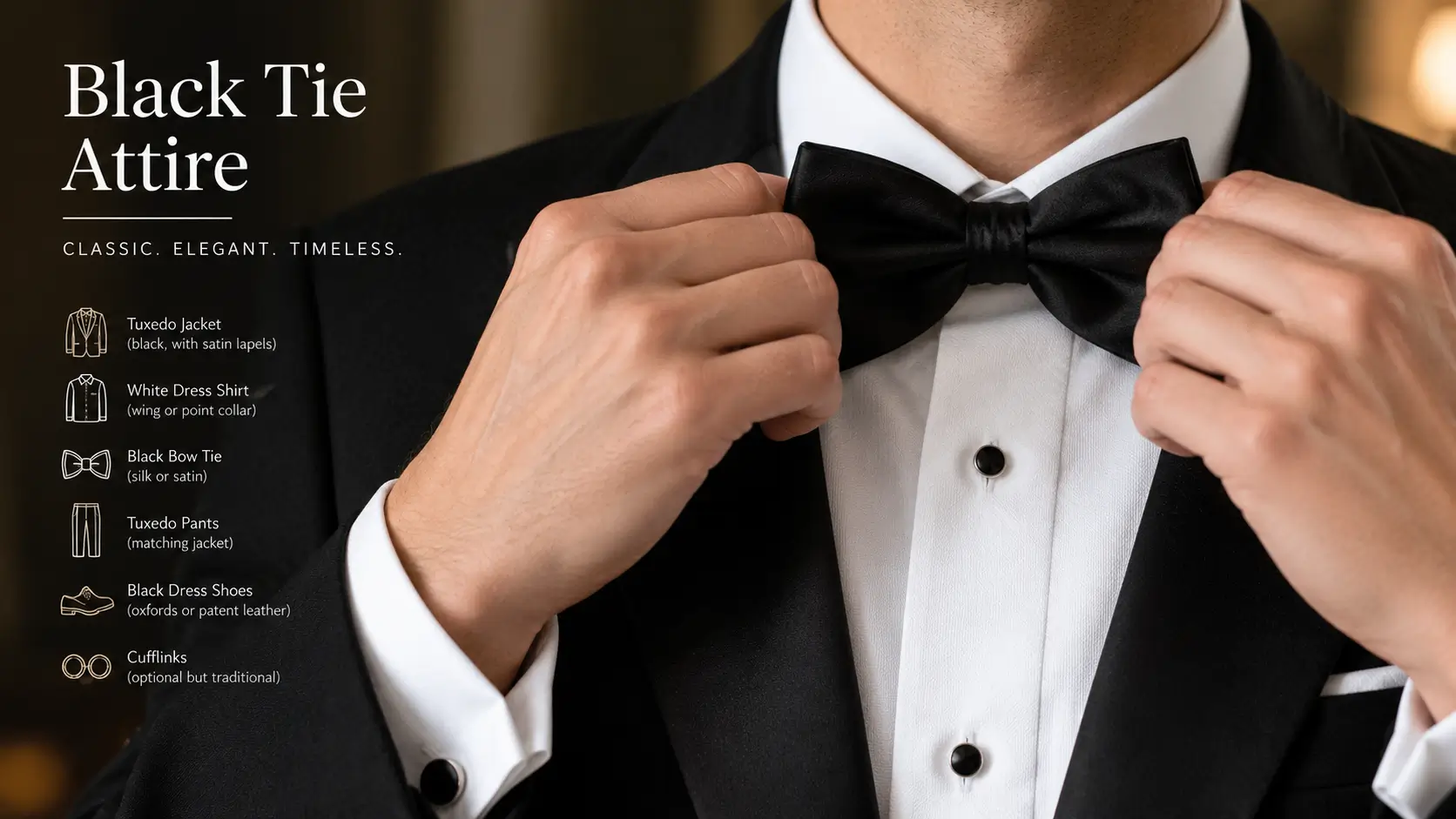
Black tie is a formal evening dress code, traditionally reserved for events starting after 6 PM. For men, it centers on a tuxedo: a black or midnight blue dinner jacket with satin or grosgrain lapels, matching trousers with a satin side stripe, a white formal shirt, a black bow tie, and polished formal shoes. For women, it means a floor-length gown, a formal cocktail dress, or increasingly, elegant separates like a tailored jumpsuit.
The dress code traces back to the late 19th century as a less rigid alternative to white tie, popularized by British aristocracy and, according to popular tradition, adopted in the US after gaining acceptance at Tuxedo Park, New York. It has since become the standard for galas, formal weddings, award ceremonies, and upscale charity events.
Black Tie vs. White Tie vs. Black Tie Optional
Confusing these three is one of the most common mistakes, and it matters because getting it wrong means being noticeably over- or underdressed.
| White Tie | Black Tie | Black Tie Optional | |
|---|---|---|---|
| Formality | Highest (state dinners, royal events) | High (galas, formal weddings) | Flexible formal |
| Men’s jacket | Black tailcoat | Dinner jacket (tuxedo) | Tuxedo preferred, dark suit acceptable |
| Men’s neckwear | White bow tie | Black bow tie | Bow tie or conservative tie |
| Women | Full ballgown | Floor-length gown or formal cocktail dress | Cocktail dress or evening separates |
White tie is genuinely rare today, reserved for state dinners and the most formal royal or diplomatic events. Black tie is the standard for most galas and upscale weddings. Black tie optional signals that a tuxedo is preferred but a well-tailored dark suit will be accepted, more on that distinction below.
Men’s Black Tie Attire
The Tuxedo
The defining feature is satin-faced lapels, either peak, shawl, or notch, with peak lapels considered the most traditional. Black and midnight blue are both correct; midnight blue often reads richer under evening lighting. A white dinner jacket with black trousers is a well-established summer variation, not a modern shortcut.
Shirt, Bow Tie & Accessories
The shirt should be crisp white, either pleated-front or Marcella (pique) front, with a wing or spread collar and French cuffs for cufflinks. The bow tie should be black silk and, ideally, self-tied rather than pre-tied or clip-on, a detail etiquette-focused sources consistently flag as the single most noticeable giveaway of an underprepared outfit. At the waist, wear either a cummerbund or a formal waistcoat, never both, unless the jacket is double-breasted, in which case a waist covering isn’t needed at all.
Shoes
Polished black patent leather Oxfords are the standard. Velvet slippers are an acceptable variation for creative black tie settings. Avoid suede entirely, and skip loafers, brogues, or anything with visible stitching detail.
Common Mistakes That Undermine the Look
- Wearing a dark business suit instead of an actual tuxedo (the satin lapel and trouser stripe are what signal “black tie,” not just the color black)
- A long necktie instead of a bow tie
- A pre-tied or clip-on bow tie
- Wearing a belt (tuxedo trousers are designed for braces or side adjusters, not belt loops)
- Skipping the cummerbund or waistcoat entirely
Women’s Black Tie Attire
Gowns and Dresses
A floor-length gown is the traditional choice, but a sophisticated cocktail dress or a formal midi is widely accepted at most modern black tie events, particularly weddings. Fabrics like silk, satin, velvet, and chiffon read appropriately formal; deep jewel tones, black, and navy are safe, elegant choices.
Black Tie Attire for Women Who Don’t Want to Wear a Dress
This is a genuinely common question, and the honest answer is yes, you have options. A formal, well-tailored jumpsuit or a dressy pantsuit in an appropriate fabric (silk, crepe, or a structured formal blend) is increasingly accepted as equivalent to a gown, especially at weddings and creative black tie events. The key is formality of fabric and cut, not the specific garment category.
Plus-Size Black Tie Attire
The same formality rules apply regardless of size, structure, quality fabric, and a fit that’s tailored rather than simply “large enough.” Floor-length gowns with a defined waist, wrap-style dresses, and tailored jumpsuits all work well and are increasingly available from mainstream formalwear retailers in extended size ranges, rather than requiring a specialty search.
Accessories and Footwear for Women
Keep jewelry elegant and understated rather than competing with the gown itself. Formal heels are traditional, but dressy flats or embellished flat sandals are increasingly accepted, particularly for outdoor or long-standing events, comfort concerns are a legitimate consideration real guests raise often. A small, structured clutch completes the look.
What to Wear to a Black Tie Wedding (As a Guest)
Weddings are where most people actually encounter this dress code, and it comes with a few of its own conventions.
For men: the same tuxedo rules apply as any other black tie event. If you don’t own a tuxedo and the invitation says “black tie” rather than “black tie optional,” renting is standard practice, not a compromise.
For women: a floor-length gown remains the traditional choice, but a formal cocktail dress or elegant separates are widely accepted at contemporary black tie weddings. One firm rule across virtually every etiquette source: avoid white, ivory, or any shade that could be mistaken for the bride’s dress.
Does Black Tie Mean You Have to Wear All Black?
No, and this is a common point of confusion, especially for guests. Black tie refers to the formality level and specific silhouette (tuxedo, gown), not a literal color requirement. Women in particular have flexibility with color, jewel tones, navy, and even black are all standard, but so are other deep, rich colors depending on the event. The exception is when a host specifically requests all-black attire as a styling choice for their event, which is a distinct, explicit request rather than the default meaning of “black tie.”
Black Tie Attire by Season
Summer and warm-weather events: a white dinner jacket with black trousers is the classic adjustment for men; lightweight wool or tropical-weight fabric helps with comfort. For women, lighter fabrics like chiffon or a formal linen blend work well, provided the silhouette stays appropriately formal.
Winter and evening galas: velvet dinner jackets or heavier wool tuxedos are common choices for men. A formal overcoat for the journey to and from the venue completes the look without compromising the outfit underneath.
Is “Black Tie Optional” Actually a Real Dress Code?
This is genuinely debated, and it’s worth knowing both sides before you rely on it. Some etiquette purists argue “black tie optional” isn’t a legitimate, clearly defined dress code at all, since it essentially asks guests to self-select their own formality level, which can result in a visibly mismatched room. Real wedding guests and planners report exactly this experience: arriving in a full tuxedo only to find half the room in business-casual suits, or vice versa.
The practical guidance that holds up regardless of which side of that debate you land on: when in doubt, dress toward the more formal end. A tuxedo at a black tie optional event never reads as a mistake; an underdressed suit sometimes does.
Rent or Buy?
If you attend formal events only occasionally, renting a tuxedo remains the more practical choice, lower upfront cost, no storage concern, and no risk of a garment falling out of fashion before you wear it again. If formal events are a recurring part of your calendar, several a year, a well-made, properly tailored tuxedo typically becomes more cost-effective after three or four wears, and consistently fits and looks better than a generic rental.
Frequently Asked Questions
What is black tie attire, in simple terms?
For men, a tuxedo: dinner jacket, matching trousers, white formal shirt, black bow tie, and polished dress shoes. For women, a floor-length gown, formal cocktail dress, or elegant formal separates like a tailored jumpsuit.
Can a woman wear pants to a black tie event?
Yes. A well-tailored, formal pantsuit or jumpsuit in an appropriately dressy fabric is increasingly accepted as equivalent to a gown at most modern black tie events, particularly weddings.
Can a woman wear a short dress to a black tie event?
A sophisticated cocktail-length dress is widely accepted at contemporary black tie events, especially weddings, though a floor-length gown remains the more traditional choice for the most formal galas and award ceremonies.
Does black tie mean you have to wear black?
No. Black tie refers to the formality and style of the outfit (tuxedo for men, gown or formal separates for women), not a literal color rule. Deep jewel tones, navy, and other rich colors are all standard choices for women unless a host specifically requests all-black attire.
What’s the difference between black tie and black tie optional?
Black tie requires a tuxedo for men and a gown or equivalent formal option for women. Black tie optional signals that a tuxedo is preferred but a well-tailored dark suit is acceptable if you don’t own one, giving guests some flexibility.
What should men wear to a black tie wedding if they don’t own a tuxedo?
Renting is standard practice and widely expected, not seen as a compromise. If the invitation says “black tie” rather than “black tie optional,” a rented tuxedo is the appropriate choice over a dark suit.
About the Author

Nicola Ebmeyer has spent over nine years in fashion and beauty editorial, covering skincare, aesthetics, and non-surgical treatments for beauty and lifestyle publications before shifting focus to medical aesthetics content. She has interviewed dermatologists and cosmetic injectors extensively and specializes in translating clinical information into clear, honest guides for people considering their first treatment. You can reach Nicola at nicolaebmeyerr@gmail.com.
More from Insight Bullion