

Disclosure: This article is general educational information, not tax advice. Deduction limits change by tax year, so confirm current figures on IRS.gov or with a licensed tax professional before filing.
Few tax terms cause as much confusion as adjusted gross income. It sounds like your salary, it isn’t on your W-2, and it gets mixed up with taxable income, net income, and MAGI. Here’s what AGI actually is, where to find it, and how to work it out yourself.
The Short Answer
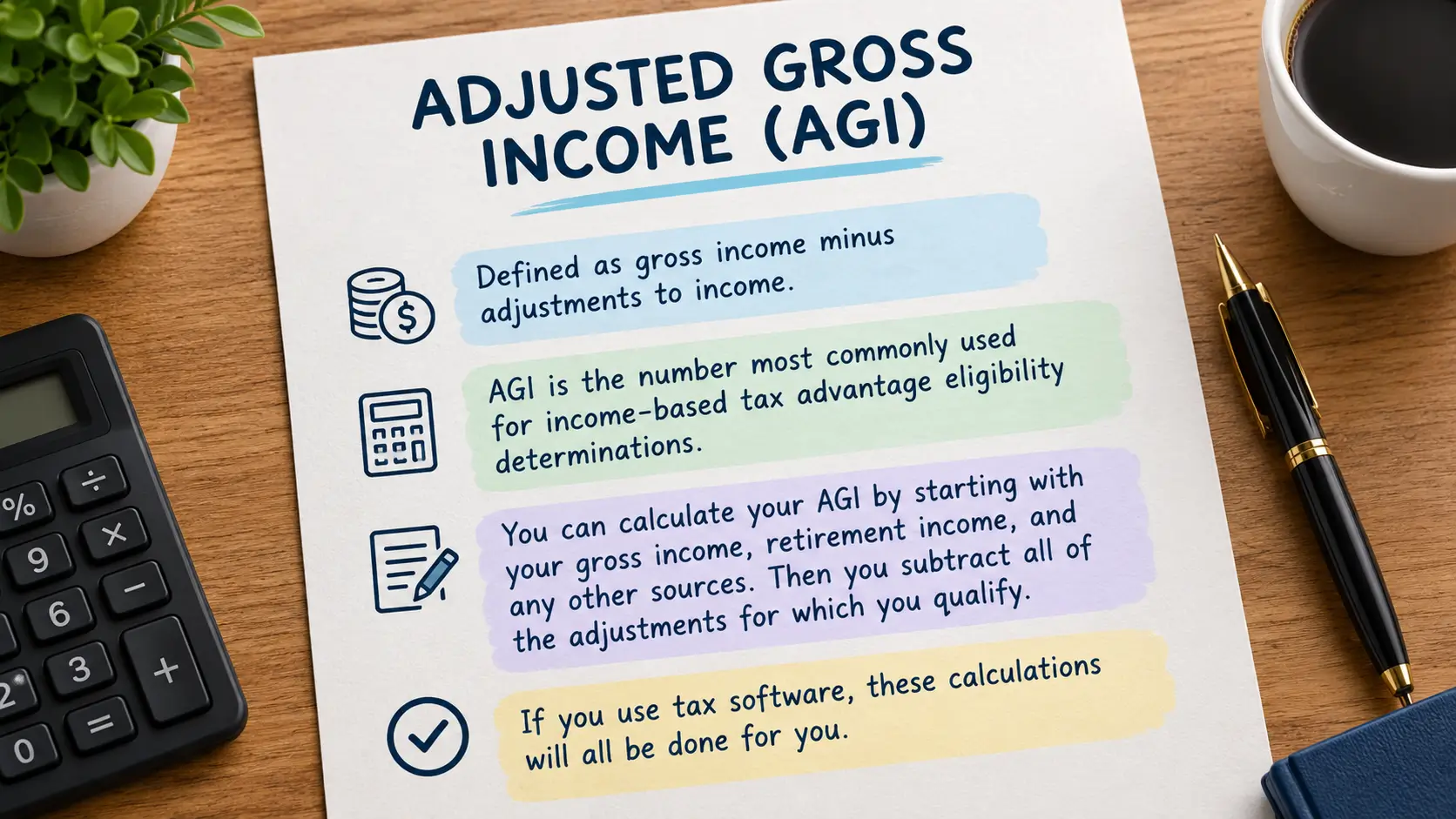
Adjusted gross income (AGI) is your total taxable income for the year minus a specific set of deductions called “above-the-line” adjustments. It is calculated before your standard or itemized deduction, and it is the starting point for working out your taxable income and your tax bill.
The AGI Formula
Gross income − above-the-line deductions = AGI
Your AGI shows up on Line 11 of Form 1040 (for the 2024 and 2025 returns).
What Counts as Gross Income
For most people, the biggest piece is job income from a W-2. Other taxable income is added in too:
- Wages and tips
- Self-employment income
- Interest and dividends
- Capital gains
- Rental income
- Pension income
- Taxable Social Security payments
- Unemployment compensation
- Pass-through income from a partnership or S corporation
- Taxable alimony payments
What Gets Subtracted: Above-the-Line Deductions
These adjustments reduce your AGI directly, and you can claim them even if you don’t itemize:
- Educator expenses
- Health Savings Account (HSA) deduction
- Traditional IRA contributions
- Student loan interest deduction
- One-half of self-employment tax
- Self-employed health insurance deduction
- Certain self-employed retirement contributions (SEP IRA or Solo 401(k))
- Military moving expenses
The standard deduction and itemized deductions are not part of this list. They’re “below-the-line” and come after AGI.
A Simple AGI Example
An illustration with round numbers:
| Item | Amount |
|---|---|
| Wages from W-2 | $60,000 |
| Interest income | $500 |
| Gross income | $60,500 |
| HSA deduction | -$3,000 |
| Student loan interest deduction | -$1,000 |
| Adjusted gross income | $56,500 |
From there, you’d subtract your standard or itemized deduction to reach taxable income. That step happens after AGI, not before it.
Where to Find Your Adjusted Gross Income
On Your Tax Return
Look at Line 11 of Form 1040, 1040-SR, or 1040-NR. If you’re searching for “what line is adjusted gross income,” that’s the answer for recent returns. Older returns used different line numbers, so check the form’s labels rather than assuming the same line.
On a W-2? No.
AGI is not shown on a W-2, and it isn’t on your paycheck stub or a 1099 either. You calculate it from several sources, using your W-2 as one input. If you’re looking for “adjusted gross income on W-2,” the honest answer is that it isn’t there.
Finding Last Year’s AGI
If you need your prior-year AGI (for example, to e-file), you have a few routes:
- Check your copy of last year’s return, Line 11.
- View or download a transcript online through your IRS online account.
- Request a transcript by mail, which generally takes 5 to 10 business days.
- If you and your spouse filed jointly last year, your spouse’s AGI is the same as yours. If you filed separately, you’ll need their return or transcript.
AGI vs. Gross Income vs. Taxable Income vs. Net Income vs. MAGI
| Term | What it means |
|---|---|
| Gross income | All income from all sources, before deductions |
| AGI | Gross income minus above-the-line deductions |
| Taxable income | AGI minus the greater of your standard or itemized deduction. This is what your tax brackets apply to |
| MAGI | AGI with certain items added back or subtracted. There’s no single fixed definition, since it varies by tax benefit |
| Net income | A business or accounting term, money left after expenses. Not the same as AGI |
The most common mix-up is AGI versus taxable income. They are not the same thing: taxable income is calculated from your AGI, one step further down.
Is Adjusted Gross Income Before or After Taxes?
Before. AGI is calculated before income tax is figured, and it’s the number used to determine your tax. It’s also not “after the standard deduction”, the standard deduction is subtracted afterward to get taxable income.
Why AGI Matters
AGI isn’t just a stepping stone on the tax form. It also affects:
- Which credits and deductions you qualify for. Many phase out as AGI rises, until they’re reduced or unavailable.
- Education tax credits. The American Opportunity and Lifetime Learning credits phase out at higher income levels.
- Other financial situations, including applying for a loan, renting an apartment, or student aid. FAFSA, for example, pulls tax information that includes AGI.
How to Lower Your AGI Legally
You can reduce AGI by claiming eligible above-the-line deductions. Common routes, with the figures cited in the source material for this article:
- HSA contributions: up to $4,400 for self-only coverage and $8,750 for family coverage for 2026, plus an extra $1,000 for those 55 and older. Contributions can be made until the tax deadline.
- Traditional IRA contributions: a deduction limit of 7,000for2025(8,000 if you’re 50 or older), though your income and any workplace retirement plan can limit the deductible amount.
- Student loan interest: up to $2,500, limited by income.
- Educator expenses: up to 300for2025(600 for married educators filing jointly, up to $300 each).
- Self-employed deductions: half of self-employment tax, self-employed health insurance, and SEP IRA or Solo 401(k) contributions.
These limits change from year to year, so verify the current numbers before you rely on them.
Frequently Asked Questions
What does adjusted gross income mean?
It’s your gross income minus specific above-the-line deductions, and it’s the starting point for calculating taxable income.
Where is adjusted gross income on a 1040?
Line 11 of Form 1040 for the 2024 and 2025 returns.
Is adjusted gross income on my W-2?
No. AGI is calculated from several sources and doesn’t appear on a W-2, paystub, or 1099.
Is adjusted gross income the same as taxable income?
No. Taxable income is AGI minus your standard or itemized deduction.
Is adjusted gross income before or after taxes?
Before. It’s calculated before income tax is figured.
Does adjusted gross income include the standard deduction?
No. The standard deduction is subtracted after AGI to get taxable income.
How do I find my AGI from last year?
Check Line 11 on last year’s return, view a transcript in your IRS online account, or request a transcript by mail (about 5 to 10 business days).
What’s the difference between AGI and MAGI?
MAGI is your AGI with certain items added back or subtracted, depending on the specific tax benefit being tested.
About the Author

Chris Tzitzis writes about personal finance, taxes, investing and cryptocurrency, with more than 10 years of experience explaining money topics to everyday readers. His work focuses on turning rules and fine print, including how crypto is taxed, into clear steps people can verify for themselves. You can reach Chris at christzitziis@gmail.com.
More from Insight Bullion