
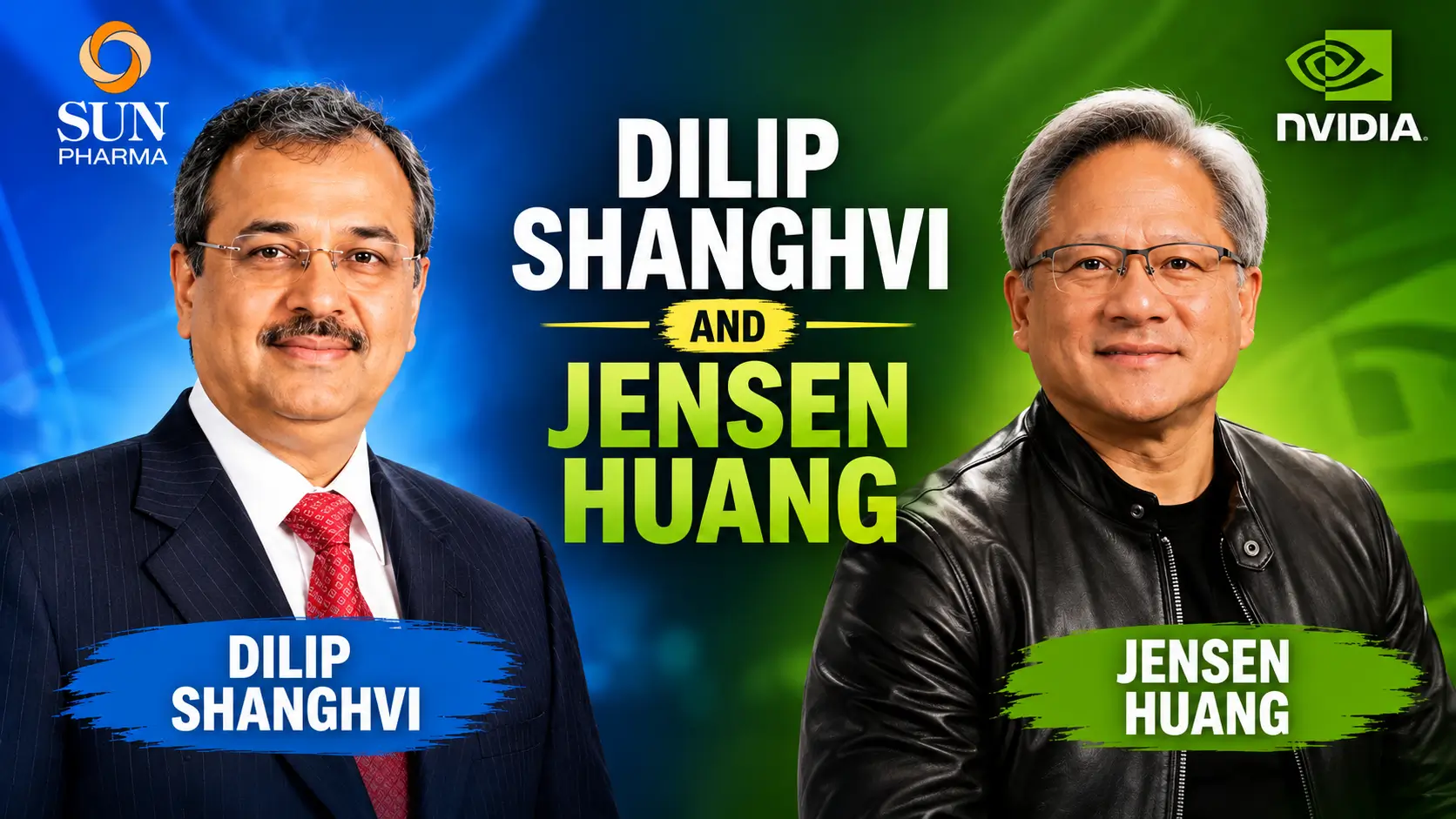
Dilip Shanghvi and Jensen Huang are two of the most recognizable founder-led business leaders alive today one built India’s largest pharmaceutical company, the other built the chipmaker now powering the global AI boom. Their names are increasingly searched together, but there’s no documented business partnership, family tie, or joint venture connecting them. What connects them is a comparison worth making: two very different founders who each turned a modest, narrowly focused startup into a company with outsized global influence.
Quick answer: Shanghvi founded Sun Pharmaceutical Industries in 1983 with a small loan from his father, building it into a global generics and specialty-pharma company through acquisitions like the 2014 Ranbaxy deal. Huang co-founded NVIDIA in 1993, pivoting the company from gaming GPUs into the hardware backbone of modern AI through his long bet on the CUDA computing platform. They have never been reported as business partners.
Who Is Dilip Shanghvi?
Dilip Shanghvi is the founder and Executive Chairman of Sun Pharmaceutical Industries. Born in Amreli, Gujarat, he grew up around his family’s pharmaceutical distribution business and studied commerce at the University of Calcutta a commercial, not scientific, foundation.
In 1983, at 27, he started Sun Pharma with a small loan from his father, launching with a handful of psychiatric medicines rather than competing in crowded, high-volume categories. That narrow starting point let the company build deep relationships in chronic-therapy areas like neurology, cardiology, and psychiatry before expanding.
The company’s defining moment came in 2014, when Sun Pharma acquired the scandal-hit Ranbaxy Laboratories in an all-stock deal worth roughly $4 billion — a contrarian bet on fixing a distressed asset that made Sun Pharma India’s largest pharmaceutical company and one of the world’s largest generics makers.
Who Is Jensen Huang?
Jensen Huang is the co-founder, President, and CEO of NVIDIA. Born in Tainan, Taiwan, he moved to the United States as a child, later earning an electrical engineering degree from Oregon State University and a master’s from Stanford. Before NVIDIA, he worked as a chip designer at AMD and LSI Logic.
In 1993, Huang co-founded NVIDIA with Chris Malachowsky and Curtis Priem. The company built its early reputation on gaming graphics cards — a narrow, overlooked niche at the time. The turning point came in 2006, when Huang committed NVIDIA to building CUDA into every GPU, a parallel-computing platform that added cost with no clear payoff for years. That bet became the foundation of NVIDIA’s AI dominance once researchers discovered GPUs could train deep-learning models far faster than CPUs.
Is There a Business Relationship Between Them?
No. There is no publicly documented partnership, joint venture, family connection, or formal business relationship between Dilip Shanghvi and Jensen Huang. Every major source covering this comparison reaches the same conclusion: their names are paired because both are influential, founder-led business leaders — not because they’ve worked together.
Side-by-Side Comparison
| Dilip Shanghvi | Jensen Huang | |
|---|---|---|
| Company | Sun Pharmaceutical Industries | NVIDIA |
| Founded | 1983 | 1993 |
| Industry | Pharmaceuticals, generics & specialty medicine | Semiconductors, GPUs & AI computing |
| Education | B.Com, University of Calcutta | BS Electrical Engineering (Oregon State), MS (Stanford) |
| Defining Move | $4B acquisition of Ranbaxy (2014) | Committing to CUDA years before AI demand existed (2006) |
| Current Role | Executive Chairman | Founder, President & CEO |
| Key Recognition | Padma Shri (2016) | IEEE Medal of Honor (2026) |
Strategy: Acquisition-Led Growth vs. Platform-Led Growth
The two founders scaled their companies in fundamentally different ways, and the contrast is instructive for anyone studying business strategy.
Shanghvi’s model leaned on disciplined acquisitions. Rather than relying only on internal R&D, Sun Pharma identified undervalued or distressed pharmaceutical assets — including Ranbaxy — and absorbed their manufacturing scale and market access while fixing compliance issues. This built Sun Pharma into a company now operating in more than 100 countries.
Huang’s model leaned on sustained platform investment. NVIDIA funded CUDA’s development for roughly a decade using profits from its core gaming business before the AI boom validated the bet. Instead of buying its way into new markets, NVIDIA built the ecosystem that new markets would eventually depend on.
Neither approach is objectively superior — they reflect what each industry rewards. Pharmaceutical scale often comes from consolidating manufacturing and regulatory capability; computing-platform scale comes from developer adoption that compounds over time.
Leadership Style
Shanghvi is widely described as understated and analytical, delegating daily operations to domain experts while personally evaluating acquisition targets and capital allocation. He has kept a comparatively low public profile relative to his wealth and has begun visible succession planning within Sun Pharma’s leadership team.
Huang runs NVIDIA with a notably flat structure, reportedly managing dozens of executives directly rather than through layered hierarchy, and is known for pushing teams toward first-principles problem-solving. Unlike Shanghvi, Huang has not disclosed a formal succession plan.
Net Worth: What’s Actually Verifiable
Billionaire net worth is a volatile, frequently re-estimated figure tied to share price — not a fixed number. As of late 2026, tracking services and Forbes estimates place Shanghvi’s fortune roughly in the $20–28 billion range, consistently ranking him among India’s top ten wealthiest individuals. Huang’s fortune, tied almost entirely to his roughly 3% NVIDIA stake, has been estimated near $165–200 billion in the same period, following NVIDIA’s rise past a $5 trillion market capitalization in October 2025.
Both figures should be treated as snapshots rather than fixed facts — check a live tracker (Forbes Real-Time Billionaires or Bloomberg Billionaires Index) for the current number rather than relying on any single published figure.
What Each Leader’s Career Teaches
- Start narrow, then expand. Shanghvi built credibility in psychiatric medicine before diversifying; Huang built credibility in gaming GPUs before expanding into AI computing.
- Patience beats prediction. Neither founder’s biggest win came from correctly timing a market. Huang funded CUDA for years before AI demand arrived; Shanghvi built Sun Pharma over decades rather than chasing a single breakout product.
- Scale founder equity doesn’t have to mean scale founder control. Huang holds roughly 3% of NVIDIA yet retains strategic authority through decades of technical leadership — a reminder that influence and ownership percentage aren’t the same thing.
- Risk looks different by industry. Shanghvi’s biggest risk was a distressed acquisition with regulatory baggage; Huang’s was a multi-year R&D bet with no guaranteed market. Both required a tolerance for a long, uncertain payoff window.
Frequently Asked Questions
Are Dilip Shanghvi and Jensen Huang business partners?
No. There is no publicly documented partnership, joint venture, or formal business relationship between them.
Who is richer, Dilip Shanghvi or Jensen Huang?
As of late 2026, Jensen Huang’s net worth (roughly $165–200 billion) is substantially higher than Dilip Shanghvi’s (roughly $20–28 billion), driven primarily by NVIDIA’s market capitalization growth. These figures change frequently and should be checked against a live tracker.
What companies did they found?
Dilip Shanghvi founded Sun Pharmaceutical Industries in 1983. Jensen Huang co-founded NVIDIA in 1993 along with Chris Malachowsky and Curtis Priem.
What is the biggest similarity in their careers?
Both built companies that expanded far beyond their original, narrow starting markets — Sun Pharma from psychiatric medicines into global specialty pharma, and NVIDIA from gaming graphics into AI infrastructure — through patient, long-horizon investment rather than quick wins.
Is Dilip Shanghvi the richest person in India?
No. He briefly held that position in March 2015 but currently ranks among India’s top ten wealthiest individuals, behind figures such as Mukesh Ambani and Gautam Adani.
About the Author

Becky Simms is a technology writer with more than 9 years of experience covering consumer electronics, streaming services, and device troubleshooting. His work focuses on practical, verifiable guidance, helping readers tell the difference between a real service outage and a local device issue, rather than guessing based on a frozen screen.
He writes by cross-referencing official status pages and verified outage reports with what real users are experiencing in device-specific communities, so his guides reflect what’s actually happening rather than speculation. You can reach Becky at beckysiimms@gmail.com.
More from Insight Bullion