
Disclosure: This article is for informational purposes only and does not constitute investment advice. Stock prices change constantly. Always check current data and consult a licensed financial advisor before making investment decisions.
Pull up Alphabet’s stock on any brokerage app and you’ll find two nearly identical tickers, GOOG and GOOGL, trading within a dollar or two of each other, moving in near-perfect sync. It’s a genuinely confusing setup for new investors: same company, same business, two different symbols. Here’s exactly what separates them and how to decide which one to buy.
The Short Answer
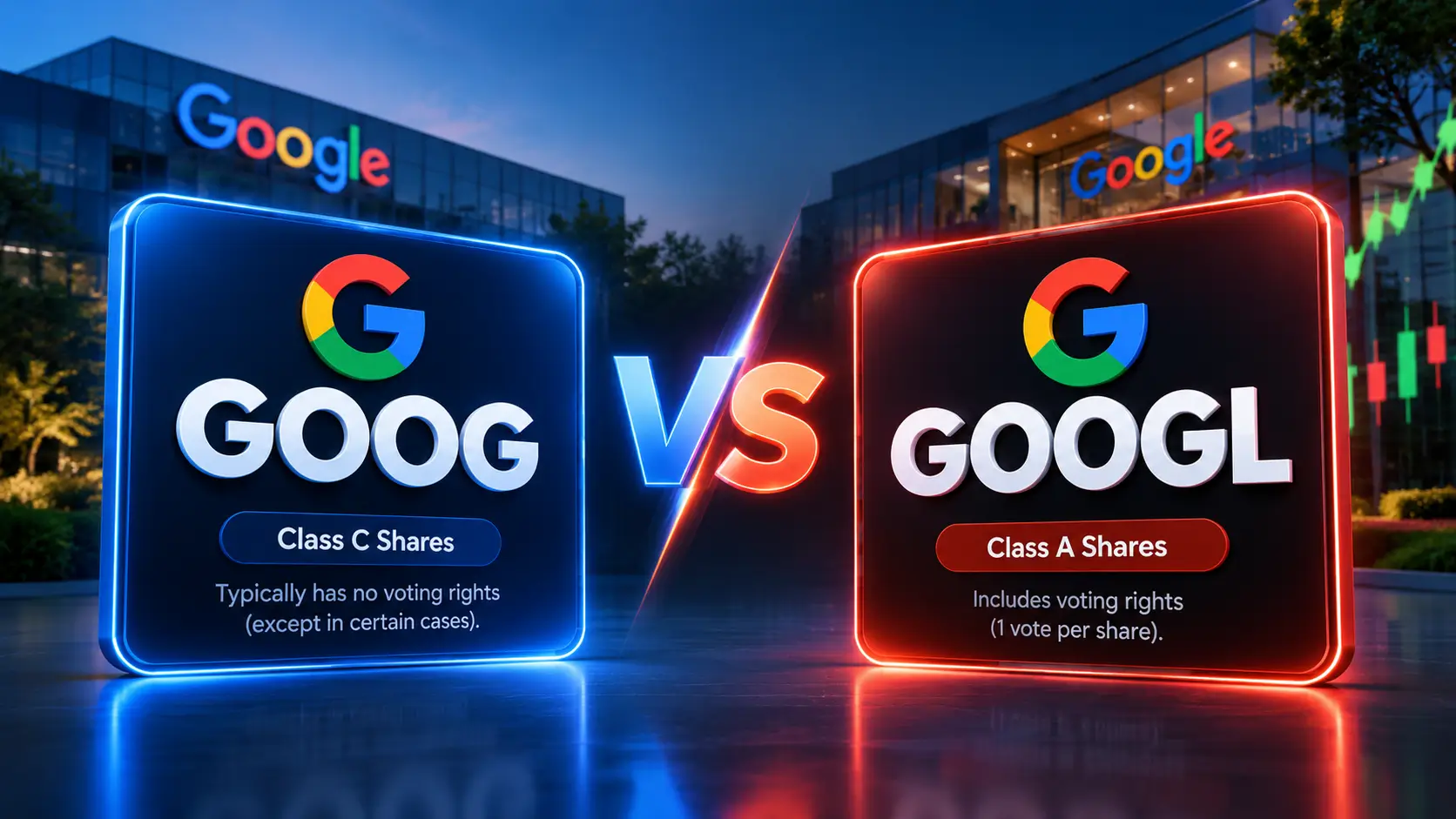
GOOGL (Class A) comes with one vote per share at shareholder meetings. GOOG (Class C) carries no voting rights at all. That’s the entire meaningful difference, both represent identical ownership in Alphabet’s business, pay the same dividend, and have nearly identical price performance over time.
Which Class Is GOOG? Which Is GOOGL?
GOOGL = Class A shares. One vote per share. Included in the S&P 500 index.
GOOG = Class C shares. No voting rights. Created in 2014 specifically to let Alphabet raise capital and compensate employees with stock without diluting the founders’ voting control.
Class B shares exist too, but they aren’t publicly traded. These are held by Alphabet insiders, primarily co-founders Larry Page and Sergey Brin, and carry 10 votes per share, which is how the founders maintain effective control of the company regardless of how public shareholders vote.
In practical terms, even GOOGL’s voting rights carry limited real influence, since Class B votes dominate any shareholder decision. For the overwhelming majority of retail investors, voting power isn’t a meaningful factor either way.
Price Difference: Why They’re Not Always the Same
Since GOOG and GOOGL represent identical economic ownership, you’d expect them to trade at exactly the same price. In practice, a small gap, typically under 1%, shows up and shifts direction over time.
Historically, GOOGL traded at a premium to GOOG, consistent with the general market pattern where voting shares command a slightly higher price. That flipped around 2020, and more recently GOOG has sometimes traded at a premium instead. The reason traced back by investors on forums and confirmed by multiple analyses: Alphabet’s share buyback program has specifically targeted GOOG shares, reducing the available float of Class C stock relative to Class A, which can push GOOG’s price up relative to GOOGL even without any change in voting-rights value.
The takeaway: whichever class happens to be cheaper on a given day gets you identical economic exposure to Alphabet for less money. Institutional arbitrage keeps the gap from growing large or lasting long, so it’s rarely worth timing a purchase around it, but if one is clearly cheaper the moment you’re buying, there’s no real downside to taking the discount.
Dividends and Economic Exposure
This part is fully identical. Alphabet pays the same quarterly dividend, $0.21 per share as of its most recent payments, to both GOOG and GOOGL holders. Your share of the company’s earnings, growth, and any future capital return is the same regardless of which class you hold.
Liquidity and Options Trading Differences
A few practical differences matter more for active traders than for buy-and-hold investors:
- GOOGL has deeper liquidity. Its S&P 500 inclusion means more institutional demand, higher trading volume, and tighter bid-ask spreads.
- Options increments differ. GOOG options typically trade in nickel increments, while GOOGL options trade in penny increments, a detail options traders specifically flag as making GOOGL more precise for strategies sensitive to small price movements.
- GOOG is excluded from certain index funds. Because major S&P 500 funds (like VOO, IVV, and SPY) hold GOOGL rather than GOOG, GOOGL benefits from consistent, structural buying from index-tracking funds that GOOG doesn’t receive.
Performance Comparison
Long-term returns between the two classes are close enough that the difference is largely academic for a buy-and-hold investor. Over a recent five-year period, GOOGL gained roughly 148% compared with GOOG’s 143%, a gap driven almost entirely by the shifting price premium discussed above rather than any real difference in the underlying business performance.
Which Should You Buy?
For most investors, there’s no strong case either way, but a few practical rules of thumb:
- If you want the marginally more liquid, S&P 500-included option and don’t mind paying a slightly higher price when GOOGL carries the premium, choose GOOGL.
- If you’re purely cost-focused and don’t care about voting rights or index fund inclusion, choose whichever class is trading cheaper on the day you’re buying.
- If you trade options actively, GOOGL’s penny increments generally offer more precision than GOOG’s nickel increments.
- If you already own one class, there’s typically no compelling reason to sell and switch to the other, doing so triggers a taxable event for a difference too small to matter for most portfolios.
Frequently Asked Questions
What is the difference between GOOG and GOOGL?
GOOGL (Class A) carries one vote per share at shareholder meetings. GOOG (Class C) has no voting rights. Beyond that, both represent identical ownership in Alphabet, including the same dividends and economic exposure.
Is GOOG or GOOGL cheaper?
It varies and shifts over time. GOOGL traditionally traded at a small premium due to its voting rights, but in more recent trading GOOG has sometimes been cheaper (or occasionally more expensive) depending on Alphabet’s share buyback activity, which has specifically targeted GOOG shares.
Which is better for long-term investing, GOOG or GOOGL?
Long-term performance between the two is very close, with differences driven mainly by the shifting price premium rather than the underlying business. GOOGL’s inclusion in the S&P 500 gives it a liquidity advantage that some long-term investors value, but neither is clearly “better” for most buy-and-hold strategies.
Does GOOG or GOOGL pay a higher dividend?
Neither. Both classes receive the identical quarterly dividend per share.
Should I buy GOOG or GOOGL for options trading?
GOOGL is generally preferred for options trading since its contracts trade in penny increments, versus GOOG’s nickel increments, offering more precision for strategies sensitive to small price movements.
Can I convert my GOOG shares to GOOGL, or vice versa?
No. You would need to sell one class and buy the other, which triggers a taxable event. Given how small the practical difference is, most investors who already hold one class have little reason to switch.
About the Author

Katherine Kerpan is a personal finance writer with over 10 years of experience covering taxes, government benefits, and consumer financial protection. His background includes several years working in tax preparation before moving into full-time financial journalism, and her writing focuses on translating IRS guidance, benefit program rules, and financial policy changes into plain language readers can actually act on.
She pays particular attention to separating confirmed government action from proposals, rumors, and scams, an area where she sees firsthand how quickly misinformation can spread once a payment claim goes viral. Every piece he publishes is checked against primary sources: IRS.gov, official agency statements, and verified legislative text, rather than secondhand claims circulating online.
When she is not writing, Katherine spends time helping family and friends untangle their own tax and benefits questions, which is usually where his best article ideas come from. You can reach Katherine at katheriinekerpan@gmail.com.
More from Insight Bullion