
Rossella Beaugié did not set out to work in travel. She was a cell biologist finishing a PhD in Paris, her husband Huw an engineer doing an MBA, and both had their careers mapped out. Then Huw’s brother died suddenly, and the question changed from what they would do next to what they wanted their lives to be for. The answer took them to Sicily, to a volcano, and eventually to one of the Mediterranean’s most admired villa companies.
In an interview with Elite Traveler, published 9 November 2026, Beaugié, co-founder of The Thinking Traveller, talks about the places that shaped her and the trip she has yet to take. Between the answers sits a clear philosophy of travel, one that has nothing to do with ticking off sights and everything to do with slowing down, choosing well, and leaving room for the unexpected.
From a Paris Laboratory to Sicily’s Villas
Beaugié grew up in Palermo, surrounded by the art and architecture of the ancient Greeks and Romans, and by Baroque and Art Nouveau buildings she says she only fully appreciated after leaving Sicily. She met Huw in Paris in 1998, while she was doing her PhD in biology and he was studying for his MBA. They married, and on a holiday back to her homeland they climbed Stromboli, the active volcano in the Aeolian Islands, then swam in the Tyrrhenian Sea. It was there, she says, that they decided to build a different life.
The couple moved to Sicily in 2002 and started small: a company called Think Sicily, offering walking tours and a handful of villas. The villas became the main business, and the portfolio grew into Puglia, other parts of Italy, and the Greek Ionian islands. In 2013 the company rebranded as The Thinking Traveller. The year 2027 marks its 25th anniversary.
Today the company is one of the few villa operators to act as sole agent for every property in its portfolio, in Italy, Greece, and Corsica, keeping a personal relationship with each owner and knowing every villa like a second home. Mishcon puts the portfolio at around 300 properties, all offered exclusively, meaning none of them appears on any other tour operator’s website.
What Traveling Well Actually Means
Asked what true luxury in travel is, Beaugié does not mention thread counts or star ratings. She says it is having someone arrange a trip who really understands you, anticipates what you need, and opens doors you might never have known existed. Someone you can trust with the details, particularly when things do not go to plan.
That definition runs through everything else she says. Traveling well, in her telling, is not about extravagance. It is about attention. It is the villa specialist who has walked the same streets as you will walk, stayed in the same villa, and met the same owner. It is the team that can arrange a soprano singing Vincenzo Bellini’s Norma by the piano in Catania for a couple’s 50th wedding anniversary, because they know the place and the people well enough to make it happen. Emirates Woman reports that the company holds a 40 percent repeat client rate, a figure Beaugié puts down to trust: guests come back because they feel better looked after than anywhere else they have tried.
The same care applies to the properties themselves. “We say we take only properties with soul,” Beaugié told Emirates Woman. “It sounds a bit fluffy, but it’s real.” Quality is the starting point, she says, but there has to be something else, and if a property is amazing yet she does not get the right feeling with the owners, it does not join the portfolio. The company invests in the villas it takes on, lending owners money to build a pool or redo the bathrooms, and manages every booking itself, so it knows every client, who goes before and who goes after.
The Villa Instead of the Hotel Suite
Beaugié prefers private homes to hotel suites, and her reasons are practical rather than grand. A villa gives freedom, privacy, and space: room for a large family to spread out, grounds big enough to jog inside your own estate, and nobody else’s schedule to keep. The portfolio runs from four to five bedroom villas, the core of the business, up to estates of around 15 bedrooms that work almost like private hotels, with a resident chef.
That preference is one travelers can test without booking a villa. The same question, a private home or a hotel room, sits behind our Airbnb vs Hotel comparison, and Beaugié’s answer is the same one many experienced travelers reach: when the trip is about the people you are with, the space matters more than the lobby.
The company has expanded with remarkable restraint. In 25 years it has moved slowly outward from Sicily, into select parts of the Mediterranean, and only when it can find the right small collection of villas and the right people on the ground. This year it expands into Sardinia for the first time, something Beaugié says was 15 years in the making, because the mix of quality and amenities her clients expect simply was not there before. Only once the team found Sardinian properties that could deliver the full experience did they decide the time was right.
Leaving Room for Discovery
The most useful advice in the interview is also the simplest: leave room for discovery. Beaugié deliberately gets lost. Last year in Venice, during the Biennale, she abandoned Google Maps and wandered through quieter streets, finding tiny churches, artisan workshops, and almost deserted corners she would never have seen on a planned route.
She also takes a quiet moment before leaving a place, to acknowledge where she has been and how fortunate she is to have experienced it. It is a small habit, and it is the opposite of how most people travel now, moving from one booked experience to the next with no empty space in between. Her version of a good trip has empty space built in: no schedules, no agenda, and time to notice what is actually there.
That is also how she switches off. Last summer in Greece, her family spent two weeks in villas right on the water on Meganisi, an Ionian island, living what she calls a proper Italian style villeggiatura: sunrise yoga, long swims, kayaking, reading, and listening to her children playing guitar and telling stories. Her three children are now 22, 20, and 18, and increasingly live their own lives, but travel, she says, has a way of drawing everyone back into the same orbit.
She cares about the small sensory details too. Views, light, and smell matter to her, including the Italian expression “profumo di pulito”, the scent of clean, with crisp linen, comfortable pillows, and freshly laundered sheets. And she likes to leave a place tidy, just as she found it.
The Places That Shaped Her
The interview is built around firsts and lasts, and the answers sketch a travel life.
The first hotel that wowed her was Hotel Raya in Panarea, in the Aeolian Islands, visited in her early twenties: views of Stromboli erupting across the sea, the simplicity of Aeolian architecture, and an atmosphere she has never forgotten. It was on Stromboli that she and Huw decided to create The Thinking Traveller, and where they started the Sicily Environment Fund.
Her earliest first class memory is a teenage surprise: an unexpected upgrade on a TWA flight to New York with her parents for a road trip, being told “you can go upstairs”, and finding the flight back in economy a comedown. The first place that changed how she saw the world was Burma, her first encounter with Buddhism, which gave her a different relationship with spirituality, nature, and everyday life.
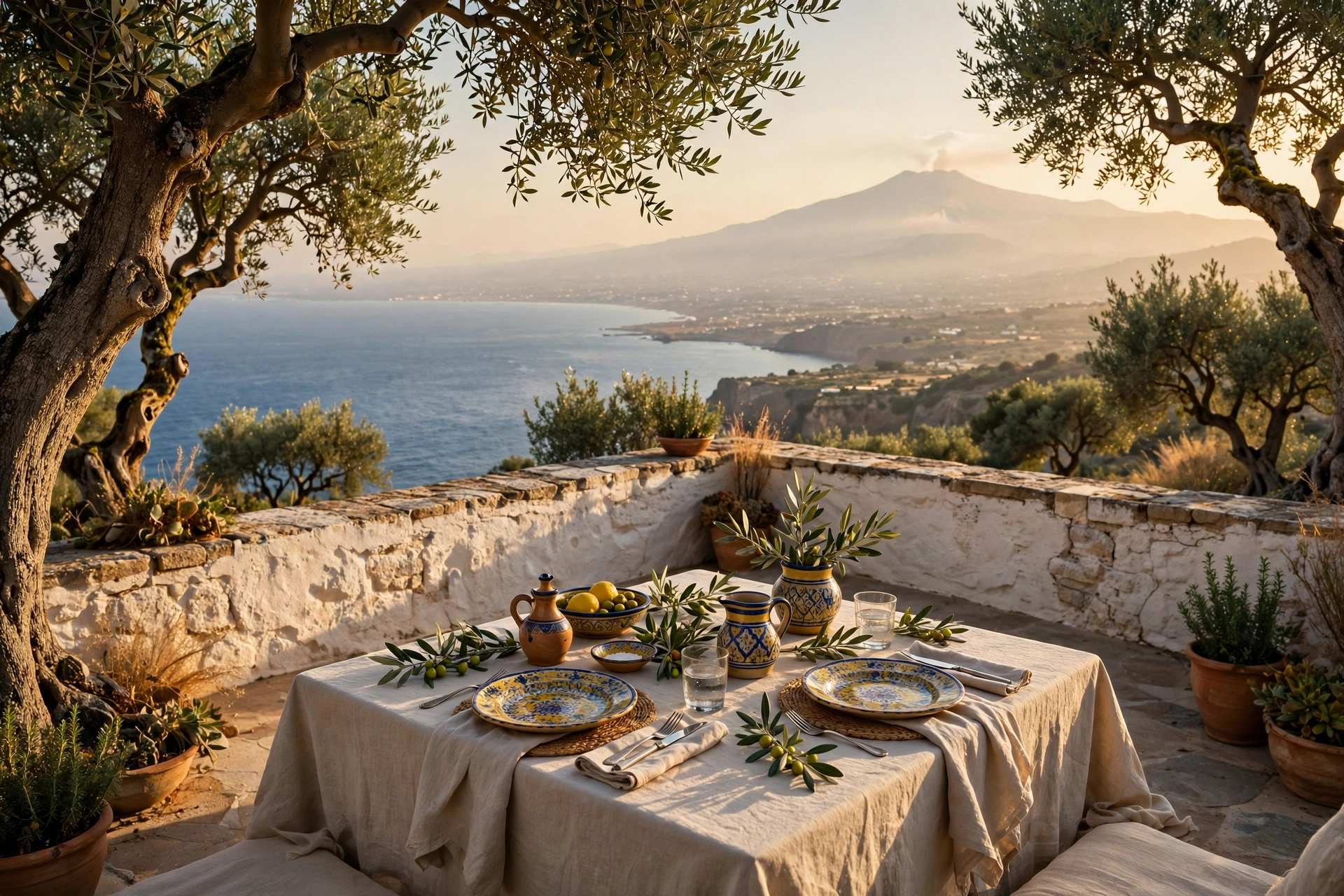
Her last trip was to the Ionian Riviera in Sicily, to Rocca delle Tre Contrade, a converted wine estate on the slopes of Mount Etna, which she describes steaming away in the background. She praises the house, the warmth and generosity of the people who look after it, and food from the estate’s own gardens, including a ceviche “alalunga” made from Albacore tuna by Dora, the estate’s longtime head chef, which she calls heavenly: full of flavor yet wonderfully light, with intense flavor from produce grown in rich volcanic soil. The last thing she bought on her travels was ceramics from the workshop of Duchess Guarini, owner of Palazzo Ducale Guarini in Puglia, under whose guidance she made a pot herself.
The one journey she has yet to take is India, a place she and Huw have always wanted to go but have not yet reached. She would stay at the Taj Mahal Palace and in intimate heritage homes, take a yoga and Ayurveda retreat, then head to the Andaman Islands for scuba diving, eating fragrant regional dishes and responsibly sourced local seafood.
Why Slow Travel Is Having a Moment
Beaugié’s philosophy lands at a time when the fastest growing complaint about travel is that it feels rushed, crowded, and interchangeable. Her answer is not a new app or a new destination. It is an older idea: fewer places, chosen with care, stayed in properly, with people who know them.
That is also a business model, and the numbers suggest it works. A 40 percent repeat rate in a market saturated with choice, a portfolio built one villa at a time over nearly 25 years, and a Sardinia launch that waited 15 years for the right properties are all the same story told three ways: patience as a strategy. The company does not go into a destination blind, Beaugié says. It explores, checks whether it can find the right small collection of villas and the right people on the ground, and only then commits.
For travelers, the lesson is portable even without a villa budget. Pick one place instead of three. Stay in a home rather than a hotel when the trip is about the people you are with. Leave an afternoon unplanned. Put the map away once a day and see what you find. And before you leave, take a moment to notice that you were there at all.
It is a modest list, and that is the point. The art of traveling well, as Beaugié tells it, is not something you buy. It is something you leave room for.
Frequently Asked Questions
Who is Rossella Beaugié?
Rossella Beaugié is a London-based Sicilian and co-founder of The Thinking Traveller, a luxury villa company. She was a cell biologist doing a PhD in Paris before she and her husband Huw moved to Sicily in 2002 and started the company, first as Think Sicily and from 2013 as The Thinking Traveller.
What is The Thinking Traveller?
The Thinking Traveller is a luxury villa company offering around 300 properties across Sicily, Puglia, Corsica, and Greece, all exclusively through the company. It is one of the few villa operators to act as sole agent for every property in its portfolio, and 2027 marks its 25th anniversary.
What does Beaugié mean by the art of traveling well?
She means choosing slowly and traveling attentively: staying in a private home with space and privacy, trusting someone who really understands you to arrange the details, leaving room for discovery, deliberately getting lost, and taking a quiet moment before leaving a place to appreciate it. True luxury, in her words, is not extravagance but being looked after by people who anticipate your needs.
Where does The Thinking Traveller have villas?
In Sicily, Puglia, Corsica, and the Greek islands, with a Sardinia expansion launching after 15 years of preparation. The portfolio runs from four to five bedroom villas, the core of the business, up to estates of around 15 bedrooms with a resident chef.
What was the first hotel that wowed her?
Hotel Raya in Panarea, in the Aeolian Islands, visited in her early twenties. She remembers the views of Stromboli erupting across the sea, the simplicity of Aeolian architecture, and the atmosphere. It was on Stromboli that she and Huw decided to create The Thinking Traveller.
Where does she most want to go next?
India, a place she and Huw have always wanted to visit but have not yet reached. She would stay at the Taj Mahal Palace and in intimate heritage homes, take a yoga and Ayurveda retreat, then go to the Andaman Islands for scuba diving and regional food.
About the Author
Carlo Dibello is a travel writer who builds guides from trips actually taken and places personally tested. Carlo covers city guides, itineraries, food, and budget travel, comparing stays, transport, and attractions on the ground before recommending them, so readers get practical plans rather than generic lists. On Insight Bullion, Carlo’s work includes city things-to-do guides, seasonal trip ideas, and head-to-head travel comparisons.
More from Insight Bullion