

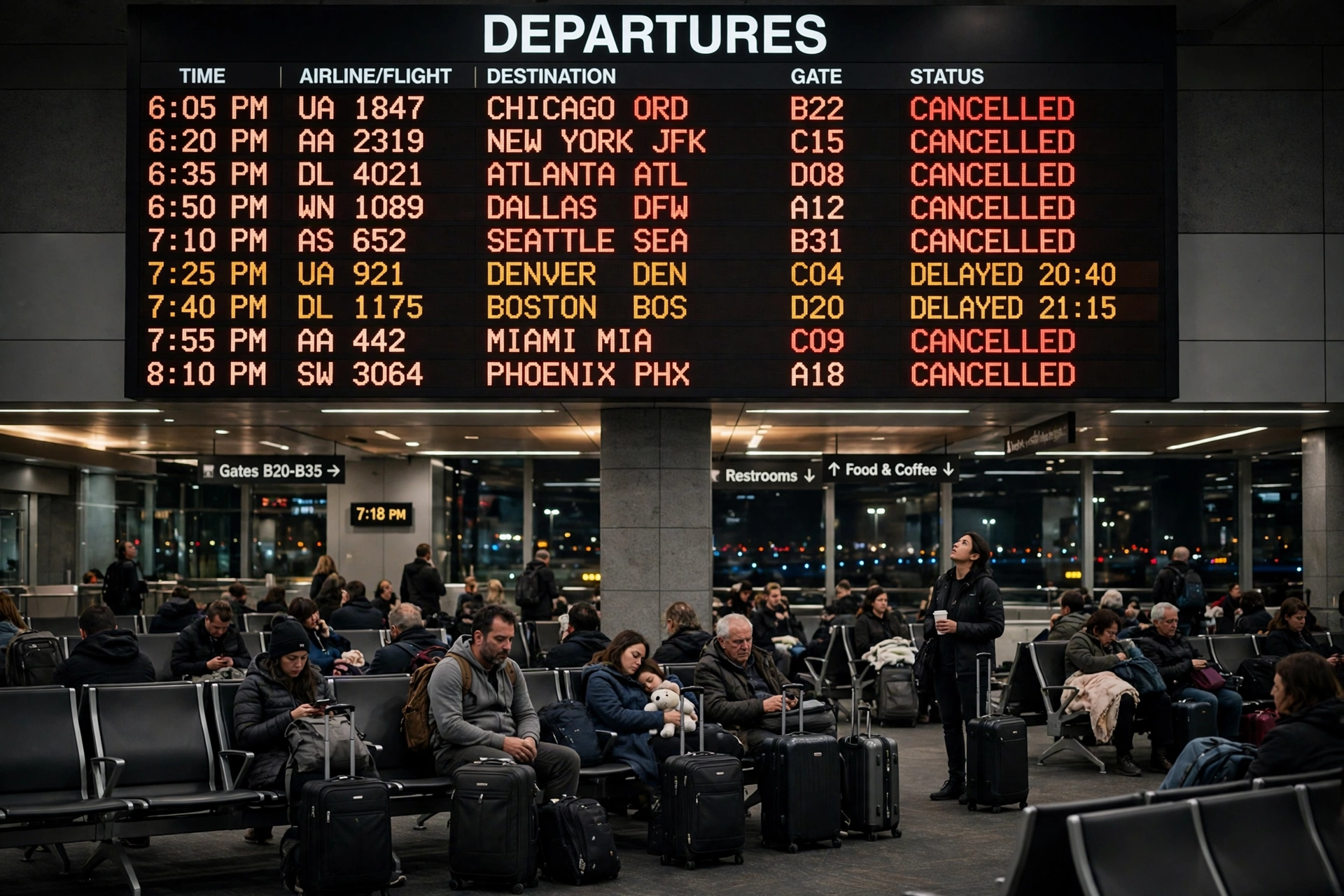
The FAA has ordered airlines to cut domestic flights at 40 of the busiest airports in the United States, and the disruption is already showing up on departure boards. The cuts took effect on Friday, 7 November 2026, with more than 1,000 flights cancelled and more than 4,300 delayed on the first day alone, according to FlightAware. The cuts start at 4 percent and rise to 10 percent by 14 November if the government shutdown continues.
This guide explains what the FAA ordered, which airports are affected, how bad the cancellations get in the coming days, and what to do if your flight is cancelled. The most useful part for most travellers is the refund rule, because a cancelled flight gives you a right to your money back, and accepting a rebooking gives that right up.
What the FAA ordered
The FAA emergency order was announced on Wednesday, 5 November by Transportation Secretary Sean Duffy and FAA Administrator Bryan Bedford. It took effect on Friday, 7 November, and applies to domestic flights only, between 6 a.m. and 10 p.m., at 40 high traffic airports. International flights are exempt.
Airlines must cut 4 percent of their domestic flights at the affected airports from 7 November, rising to 6 percent by 11 November, 8 percent by 13 November, and 10 percent by 14 November if the shutdown continues. Airlines choose which flights to cancel, and they face a fine of 75,000 dollars for each flight they operate above the limit. The limits stay in place for as long as the shutdown continues, and they should lift once Congress funds the government again.
Why the cuts are happening
The cause is the federal government shutdown, which began on 1 October. Friday, 7 November was day 38 of the shutdown, making it the longest in American history, passing the 35 day record set in 2018 and 2019. About 13,000 air traffic controllers and 50,000 airport screeners have been working without pay since the shutdown began, and the FAA said the cuts are a safety measure to relieve pressure on controllers. It is the first nationwide cut of its kind since 9/11.
The staffing strain was already showing before the order. Controllers working without pay have been calling in sick at higher rates, and the FAA said it had to reduce traffic to keep the system safe. The cuts are not a punishment for airlines. They are a response to a system running short of the people who keep planes moving safely.
How bad it was on day one
The first day of cuts was messy. FlightAware counted more than 1,000 cancelled flights and more than 4,300 delays across the United States on Friday, 7 November. The cancellations were concentrated at the 40 airports on the list, but the effects reached further, because a cancelled Atlanta flight can strand a connecting passenger in a city that is not on the list at all.
The hardest hit airlines on day one were the regional and low cost carriers that run the most domestic flights. SkyWest cancelled 178 flights and Southwest cancelled 129, while American and United cancelled roughly 80 to 100 each. Delta cancelled about 170 flights. Looking ahead, American planned to cut about 220 flights a day through Monday, and Southwest planned about 120 cancellations a day.
Those numbers are only the start. The 4 percent cut is the smallest step on the ramp, and the disruption grows with each step.
Which airports are affected
The order covers 40 of the busiest airports in the country, spanning more than two dozen states. The list includes Atlanta Hartsfield Jackson, Dallas Fort Worth, Denver, Los Angeles, and Charlotte, plus the airports serving New York, Chicago, Washington, Houston, Miami, San Francisco, and Orlando. The full list of 40 airports is published in the Reuters factbox.
If your trip touches one of these hubs, your flight is in the pool the airlines must cut from. That includes connecting flights, not just flights that start or end at a listed airport. A journey from a small airport to a big hub can be cancelled because the hub leg is the one the airline has to drop.
Check your flight status with your airline before you leave for the airport, and sign up for text or app alerts so you hear about a cancellation before you are standing in a terminal.
What happens next
The cuts deepen on a fixed schedule. The 4 percent cut that began on 7 November rises to 6 percent by 11 November, 8 percent by 13 November, and 10 percent by 14 November if the shutdown is still going. Aviation analytics firm Cirium estimates that about 1,800 flights and 268,000 airline seats would be cut each day once the full 10 percent reduction takes effect.
The timing makes the 10 percent level the one to watch. It lands on 14 November, less than two weeks before Thanksgiving on 26 November, one of the busiest travel periods of the year. If the shutdown is still running then, the busiest travel week of the year will run straight into the deepest cuts.
There is no fixed end date. The limits stay while the shutdown continues, and they should lift once Congress funds the government again. Until then, travellers should expect the disruption to grow, not shrink.
Your flight is cancelled: what to do
A cancelled flight is frustrating, but the rules are on your side, and knowing them before you talk to the airline saves time and money.
First, check your flight status before you travel, and keep the airline app on your phone. If your flight is cancelled, do not rush to accept the first alternative the airline offers. The choice you make in that moment decides whether you get your money back.
The DOT automatic refund rule, known as 14 CFR 260, says that if your flight is cancelled or significantly changed, and you decline the alternative the airline offers, you are owed a prompt automatic refund in your original payment method. A significant change on a domestic flight generally means your arrival is delayed by 3 or more hours. The refund covers the full fare plus taxes and ancillary fees, and the airline must pay it within 7 business days for a credit card purchase, or 20 calendar days for other payment methods.
Three points matter most. First, the refund is automatic, which means you do not have to fight for it, and the airline may not substitute vouchers or credits unless you affirmatively choose them. Second, accepting a rebooking ends your right to a refund for that trip, so if you would rather have your money back, decline the rebooking and ask for the refund. Third, the United States does not require cash compensation for delays or cancellations, so the refund is the remedy, not extra compensation.
One caution is worth knowing. The DOT paused enforcement for renumbered flights, a pause extended to 7 July 2027, where you are rebooked without significant change. Do not assume a renumbered flight automatically qualifies for a refund. Check whether your arrival time actually changed by 3 or more hours.
Meal and hotel help is a different matter. It depends on the airline’s own customer service commitments and whether the disruption counts as airline controlled. A shutdown driven cancellation weakens that help, because the cause is outside the airline’s control, but your refund right stays intact either way.
How to protect your trip
A few practical steps reduce the damage if your flight is in the affected pool.
Fly nonstop where you can, because every connection is another chance for a cancellation to break your trip. Fly earlier in the day when possible, because morning flights have more options behind them if something goes wrong. Avoid tight connections, and build buffer time before anything that cannot move, like a wedding, a cruise departure, or a work meeting.
Keep every receipt if you pay for food, a hotel, or a new ticket while you are stranded. You may not get all of it back, but a clear paper trail is what any claim is built on. And if you hold travel insurance, read what it actually covers before you rely on it, because shutdown related disruption is treated differently by different policies.
The cuts are a moving situation, and the numbers will change as the shutdown continues. Check your flight, know the refund rule, and make the rebooking decision with your eyes open.
Frequently Asked Questions
Are international flights affected?
No. The order covers domestic flights only, and international flights are exempt. But a domestic connecting flight to an international departure can still be cancelled, so check the whole journey, not just the long haul leg.
Will my flight be cancelled?
Not necessarily. Airlines choose which flights to cancel within the percentage limit, so many flights at the affected airports still operate. Check your flight status with your airline, and sign up for alerts so you hear about a change early.
Can I get a refund if my flight is cancelled?
Yes. If your flight is cancelled or significantly changed and you decline the alternative the airline offers, the DOT rule requires a prompt automatic refund in your original payment method, covering the full fare plus taxes and ancillary fees.
What if the airline rebooks me on another flight?
You can accept the rebooking, but accepting it ends your right to a refund for that trip. If you would rather have your money back, decline the rebooking and ask for the refund instead.
How long will the cuts last?
The limits stay in place for as long as the shutdown continues, rising to 10 percent by 14 November. They should lift once Congress funds the government again, but there is no fixed end date.
About the Author

Carlo Dibello is a travel writer who builds guides from trips actually taken and places personally tested. Carlo covers city guides, itineraries, food, and budget travel, comparing stays, transport, and attractions on the ground before recommending them, so readers get practical plans rather than generic lists. On Insight Bullion, Carlo’s work includes city things-to-do guides, seasonal trip ideas, and head-to-head travel comparisons.
More from Insight Bullion