
A four-storey oceanfront home on the Long Beach Peninsula could not find a buyer at $4.95 million. Then the ocean came to the front door. Waves driven by the remnants of Tropical Storm Rachel smashed through the boardwalk in front of the house in mid-October 2026, city inspectors red-tagged the property as unsafe to enter, and the listing agent cut the price to $2.9 million, a drop of $2.05 million in less than two months on the market.
The home, at 6519 E Seaside Walk in Long Beach, California, is now listed as land value. It is the sharpest example yet of what happens when a luxury coastal address meets a storm the defences were not built to hold, and it comes as the City of Long Beach spends millions repairing the boardwalk and bulkhead that failed.
The Home and the Listing
The house is a 4,880 square foot waterfront estate with four bedrooms and six bathrooms across four levels, with panoramic ocean and bay views, a private lift, a wine cellar and a sauna. It sits on the Peninsula, the narrow strip of sand between Alamitos Bay and the Pacific Ocean, on the boardwalk stretch known as Seaside Walk.
The property last changed hands in 2022, when it sold for $4.75 million. It came back on the market on 26 August 2026 at $4.95 million, listed by Andrew Carter of Fiv Realty Co. At that price it sat unsold for about seven weeks, through the end of summer and into autumn, while the beach in front of it was already narrowing.
The listing still reads, in places, like an advertisement for California beachfront luxury. The top level holds the main living space, with a chef’s kitchen, a granite island, a 1,000 bottle wine cellar and a secluded back deck with bay views. The difference now is the first line of the listing, which states that the property has been red-tagged and is land value.
What the Storm Did
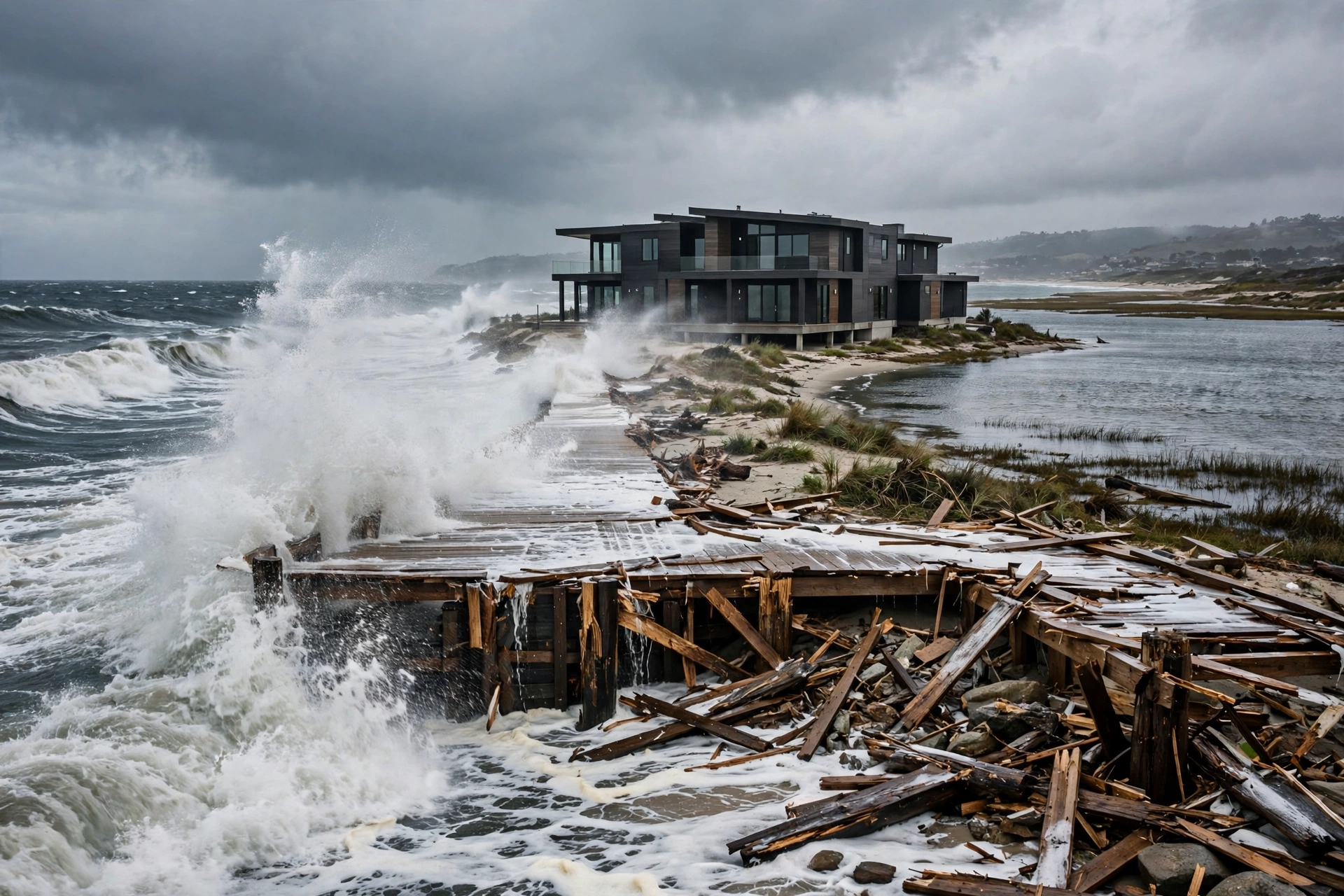
The damage came from the remnants of Tropical Storm Rachel, which pushed powerful surf onto south-facing shores in the second week of October 2026. Waves broke through the Peninsula boardwalk’s wooden bulkhead between 64th and 66th Places on Seaside Walk, tearing away about 30 feet of the structure and sending seawater into homes and streets. A photograph from 11 October shows waves crashing against East Seaside Walk as homes along the Peninsula took the full force of the surf.
The storm was not a single wave. It followed Hurricane Marie, which damaged the boardwalk and sand berm between 63rd Place and 68th Place in early September, and it arrived with high tides that stacked water higher over several days. The Los Angeles Times first reported the story of the house on 6 November 2026, noting that the home had been listed in August for $4.95 million and could not find a buyer before the storm.
City inspectors red-tagged 13 residences along the Peninsula as unsafe to enter, including homes on Seaside Walk. A red tag means the building is deemed unsafe and residents cannot stay inside until repairs are made. The home at 6519 E Seaside Walk was among them.
The $2.05 Million Price Cut
On 14 October 2026, three days after the worst of the surf, the listing price was cut from $4,950,000 to $2,900,000. That is a reduction of $2.05 million, or 41.4 percent. On a per square foot basis, the asking price fell from $1,014 to $594.
The new price is $1.85 million below what the property sold for in 2022. In effect, the market is now pricing the address as a plot of sand with a damaged structure on it, not as a finished luxury home. The listing is pitched at an investor who wants to rebuild, and the lower price has drawn fresh interest after weeks without a buyer at the original figure.
For buyers, the arithmetic is the story. A home that could not sell at $4.95 million in a calm August market lost more than 40 percent of its asking price in a single cut once the sea had been inside it. The land underneath still carries the value; the building on top of it does not, at least not at the old price.
What the City Is Doing Now
The City of Long Beach is now carrying out emergency repairs to the boardwalk and bulkhead between 64th and 66th Places on Seaside Walk, working around morning and evening low tides to stabilise the damaged infrastructure. The estimated cost of the emergency repair project has risen from an initial $1 million to $1.5 million to more than $3.6 million as crews have assessed how much of the boardwalk and bulkhead was lost. The repairs are funded through the Tidelands Emergency Reserve, with no City General Fund dollars used.
On 14 October, the city used a crane to place about 74 heavy-duty sandbags, each weighing 3,000 pounds, along the bulkhead at 65th and 66th Places. About 4,350 sandbags were distributed to residents during the Rachel storm, bringing the total to about 32,000 since Hurricane Marie.
Longer term, the city began its $11.4 million Alamitos Bay Entrance Channel Dredging Project on 20 October. The project will remove about 415,000 cubic yards of beach-ready sand from the entrance channel and place it along the Peninsula shoreline, widening the beach so it can better absorb wave energy. The city notes that sand replenishment is not a permanent solution, since waves and currents keep moving sand along the shoreline, and coastal engineers are evaluating longer-term options that will need approval from the California Coastal Commission.
What This Means for Coastal Buyers
The Long Beach sale carries a warning that reaches beyond one address. The Peninsula’s homes sit on a narrow strip of sand protected by a breakwater built in 1949, a boardwalk and a timber bulkhead. When those defences failed, the damage arrived all at once, and the market repriced the risk in days rather than years.
The wider picture is sobering. Research from the US Geological Survey, cited in California’s Fifth Climate Change Assessment, estimates that 24 to 75 percent of California’s beaches may become completely eroded by 2100, depending on sea-level rise of 1 to 3 metres. Highly developed parts of Southern California face some of the worst projected losses. The Long Beach Peninsula is an early, concrete case of that exposure: a luxury home, a famous beach, and a storm that turned a $4.95 million listing into a $2.9 million land-value sale.
Buyers looking at oceanfront property should treat this as a checklist, not a curiosity. Ask when the bulkhead, seawall or breakwater protecting the home was last rebuilt, and who pays when it fails. Check whether the home has ever been red-tagged or yellow-tagged, and whether insurance covers storm surge and erosion rather than only wind and fire. Look at the city’s repair bill, not just the listing price: Long Beach is spending more than $3.6 million on emergency boardwalk repairs and $11.4 million on dredging, and those costs say more about the risk than any brochure does. And compare the asking price with the last sale price, as here, where the $2.9 million ask sits $1.85 million below the 2022 sale. When a home is priced as land value, the buyer is buying the location and accepting the sea that comes with it.
For the Peninsula, the question now is whether the repairs and the new sand hold through the winter storm season. The home at 6519 E Seaside Walk will show the answer first: if it sells at or near $2.9 million, the market has put a price on rebuilding in the path of the next storm. If it sits, even at that price, the discount may need to go further still.
Frequently Asked Questions
Where is the Long Beach home that was cut from $4.95 million to $2.9 million?
The home is at 6519 E Seaside Walk on the Long Beach Peninsula in Long Beach, California. It is a 4,880 square foot waterfront estate with four bedrooms and six bathrooms across four levels, with ocean and bay views, a private lift, a wine cellar and a sauna.
Why was the price of the Long Beach home cut by $2.05 million?
Waves from the remnants of Tropical Storm Rachel broke through the Peninsula boardwalk’s wooden bulkhead between 64th and 66th Places in mid-October 2026, damaging the home and the shoreline in front of it. City inspectors red-tagged the property as unsafe to enter, and the listing agent cut the price from $4,950,000 to $2,900,000 on 14 October 2026, a reduction of 41.4 percent.
What does it mean that the home is red-tagged and listed as land value?
A red tag means city inspectors have deemed the building unsafe to enter until repairs are made. Listed as land value means the asking price reflects the plot rather than the damaged structure, and the listing is aimed at an investor who wants to rebuild.
How many homes on the Long Beach Peninsula were red-tagged?
City inspectors red-tagged 13 residences along the Peninsula as unsafe after the storm, including homes on Seaside Walk in the 6400 and 6500 blocks.
What is the City of Long Beach doing to repair the Peninsula?
The city is carrying out emergency boardwalk and bulkhead repairs between 64th and 66th Places on Seaside Walk, at an estimated cost of more than $3.6 million, up from an initial $1 million to $1.5 million. It also began an $11.4 million dredging project on 20 October 2026 to place about 415,000 cubic yards of sand along the Peninsula shoreline, and placed about 74 sandbags weighing 3,000 pounds each at 65th and 66th Places.
How much did the home last sell for before the storm?
The home last sold in June 2022 for $4.75 million. It was listed in August 2026 at $4.95 million, then cut to $2.9 million after the storm, which is $1.85 million below the 2022 sale price.
About the Author

Andy Abramson
Andy Abramson writes about luxury real estate, waterfront communities, and high-end lifestyle destinations. Andy’s guides focus on the detail behind a property, not just the listing: property records by address, name, and folio, closing timelines by loan type and state, and deeds and transfer rules checked against official sources, public records, and major news outlets. Andy also fact-checks high-profile homes and luxury rankings before publishing.
More from Insight Bullion