

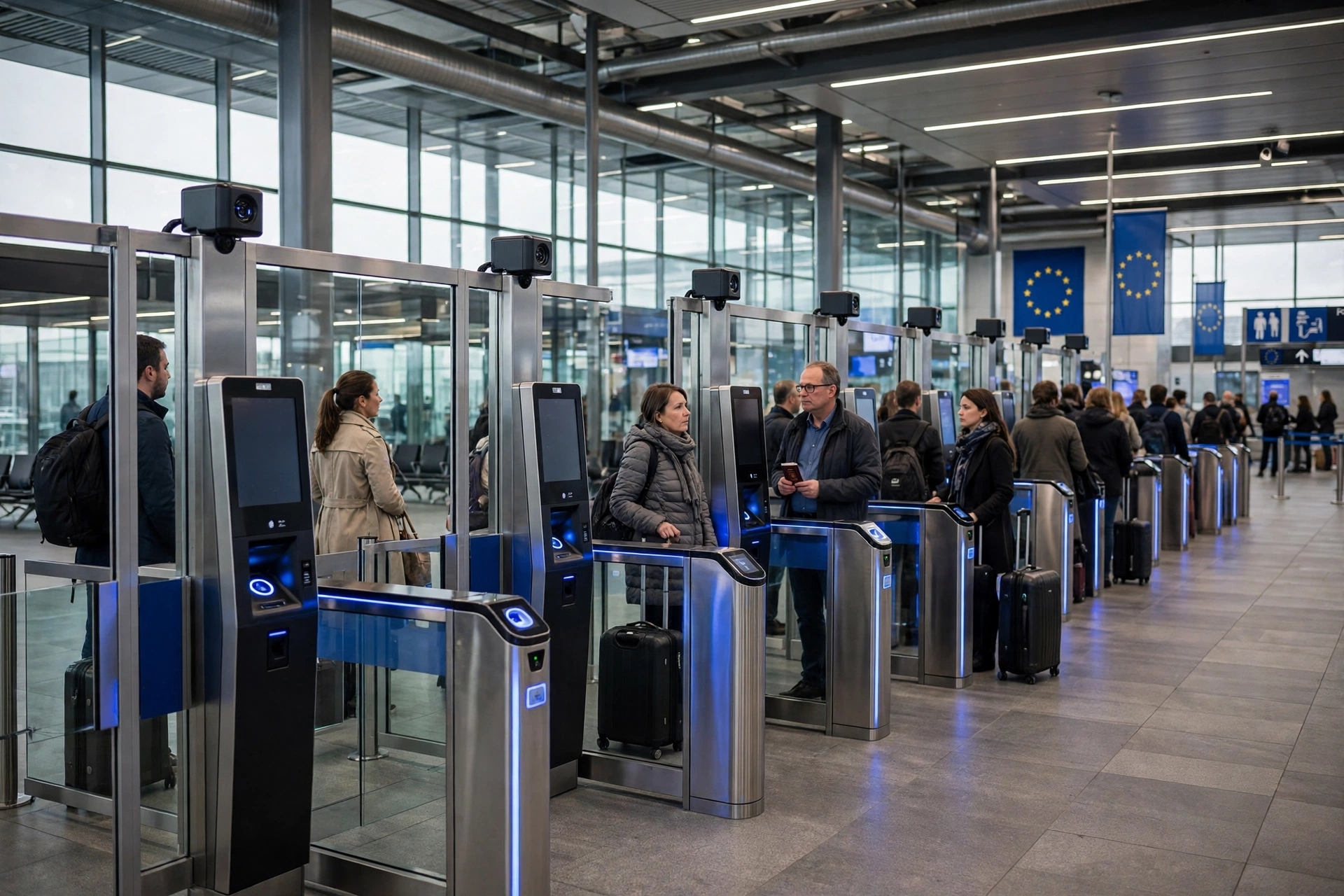
The European Union is suing IBM, Atos and Leonardo over the troubled biometric border system that now greets every non-EU traveller arriving in Europe. The case was filed almost a year ago and stayed quiet until the Financial Times reported it on 9 November 2026, citing internal communications.
The agency behind the claim is eu-LISA, the EU body that runs large-scale IT systems for the Schengen area. It says the three companies repeatedly missed deadlines while building the Entry/Exit System, known as EES, and it has now, in its own words, “activated the available contractual and legal remedies to protect its financial interests.”
The lawsuit does not claim the system is broken today. eu-LISA told the Financial Times and Reuters that the proceedings have “no impact on the functioning of the Entry/Exit System,” because the dispute covers delays during development, not how the system runs now. But the timing is awkward. The same system is currently wrongly flagging some travellers as overstayers, with at least one bestselling author warned she faces a possible two-year ban from Europe.
What the Lawsuit Is About
The claim was filed on 22 December 2025 at Harju County Court in Estonia, where eu-LISA is headquartered. The court confirmed the civil case had been filed, but no hearings have taken place and none have been scheduled. The amount eu-LISA is claiming has not been disclosed.
The dispute goes back to 2019, when eu-LISA awarded a six-year contract to build and maintain the central EES platform to a consortium of IBM Belgium, Atos Belgium and Leonardo, the Italian defence and technology group. The contract was valued at €142 million at signing. By 2021 it had grown to about €212 million, a rise the EU’s procurement records describe as covering additional services and new requirements.
The system was supposed to be ready in 2022. It was not. The phased rollout only began on 12 October 2025, and EES became fully operational at the external borders of all 29 participating countries on 10 April 2026, more than four years late.
| Date | What happened |
|---|---|
| 2019 | eu-LISA awards the six-year EES contract to IBM Belgium, Atos Belgium and Leonardo, valued at €142 million |
| October 2021 | IBM Belgium and Atos Belgium dispute a fine from eu-LISA, blaming the pandemic and other outside factors |
| 2021 | Contract value rises to about €212 million |
| February 2022 | All three companies push back against eu-LISA’s revised deadlines |
| March 2022 | IBM agrees to let eu-LISA withhold certain payments while the damages dispute is resolved |
| 2022 | eu-LISA executive director Krum Garkov says the consortium has “missed all milestones” |
| 12 October 2025 | EES begins its phased rollout |
| 22 December 2025 | eu-LISA files its lawsuit in Estonia |
| 10 April 2026 | EES becomes fully operational across all 29 countries |
| June 2026 | A new consortium wins a four-year, €93 million contract to run the central system |
| 9 November 2026 | The Financial Times reveals the lawsuit |
The Blame Game
The argument over who caused the delays started years before the lawsuit. In an October 2021 letter seen by the Financial Times, Atos Belgium and IBM Belgium contested “both the principle … and the calculation” of a fine eu-LISA had imposed, arguing that delays stemmed from external factors, including the COVID-19 pandemic.
A few months later, in February 2022, the three companies pushed back against a new set of deadlines from eu-LISA. “Ignoring reality is not prudent and will not help to achieve the plan,” they wrote, according to the Financial Times. “On the contrary, working with an unrealistic plan will cause frustration for all stakeholders.” The consortium also criticised eu-LISA’s “overall governance.”
In March 2022, IBM agreed to let eu-LISA withhold certain payments while the dispute over damages was resolved. By then the relationship was already frosty, and the costs were still climbing. In its 2022 accounts, eu-LISA acknowledged difficulties with the consortium and warned of additional costs, with the setbacks also holding up other EU IT projects. By 2023 it had nearly doubled its annual EES budget to €40 million, diverting funds from elsewhere, partly to cover rising hardware and software maintenance costs.
None of the three companies has accepted blame in public. Atos and Leonardo declined to comment to the Financial Times, and IBM did not respond. IBM and Atos also did not respond to questions from The Register.
What EES Actually Does to Travellers
EES replaces passport stamping for non-EU nationals making short stays in the Schengen area. At the border, a traveller’s passport is scanned and a facial image is taken; visa-exempt travellers also give four fingerprints. Children under 12 are not fingerprinted. Every entry and exit is recorded centrally, and the system counts the 90 days a visitor is allowed within any rolling 180-day window, flagging overstays automatically.
It applies at the external borders of 29 countries: the 25 EU members in Schengen plus Iceland, Liechtenstein, Norway and Switzerland. Ireland and Cyprus do not use it, and passports are still stamped there. There is no application and no fee. It is not a visa, and it is not the same as ETIAS, the separate pre-travel authorisation for visa-exempt visitors, which has also been delayed and is now expected in 2027.
In practice, the rollout has been rough. Some border crossings struggled to implement the mandatory fingerprint and facial checks, and nine Schengen countries sought additional time to complete implementation. Governments and transport operators invested heavily in biometric kiosks and border infrastructure, but some installations have sat underused amid software problems and delays to local deployment. In June 2026, Frontex warned that long lines at EES entry points could last for two more years. Over the summer, several countries suspended the system because of technical problems and staff shortages, and border guards went back to stamping passports by hand. At their worst, airport queues stretched to five hours.
Wrongly Flagged as Overstayers
The most serious problem is not the queues. It is the records. Since EES went fully live, some travellers say the system has failed to log their departures, so it treats them as if they never left.
Bestselling novelist Jojo Moyes spent only 23 days in the EU over six months. Yet French border guards detained her after a holiday and accused her of overstaying, because the system had not recorded her exit from Portugal in May. “The clock had been ticking ever since,” she told the consumer group Which?. A senior officer in Marseille warned her not to return to Europe until her record is fixed, or she risks a €10,000 fine and a two-year ban.
She is not alone. Jane Nolan and her husband spent 40 days in France in April. The EU’s online checker now shows they have no days left. In a case reported by the Telegraph, a British holidaymaker was detained at the Italian border and deported under police guard after a system error suggested she had overstayed. The Nolans received manual stamps in June, when France had paused the system, and still do not know which record caused the error.
The UK government is now pressing Brussels. “We are aware of reports of inaccuracies in some EES records affecting British nationals, including incomplete records and the registration of some individuals who are exempt from EES. We are raising these issues as part of our engagement with the European Commission,” a Foreign Office spokesperson said.
Rory Boland, editor of Which? Travel, called it “one of the most serious in a long line of European border control failures.” Travellers can check their remaining days online using their passport number, but to correct a wrong record they must contact the data controller in the last Schengen country they visited. Moyes says she has tried every avenue for two weeks and has hired an immigration lawyer. “Not everyone is lucky enough to be able to afford this remedy. I have no idea how much time they think I have spent in Europe, and no idea whether I am safe to travel,” she said.
The Fraud Investigation
The project has drawn scrutiny beyond the contract dispute. The EU’s anti-fraud office, OLAF, found sufficient grounds for further investigation, according to an internal report seen by the Financial Times, although it referred the matter back to eu-LISA despite describing the agency’s initial assessment as insufficient.
Separately, European prosecutors investigated software procurement through Atos’s Moscow office, following questions about purchases made in 2021, before the company divested its Russian operations. That investigation is distinct from the contractual dispute, and eu-LISA has said it identified no security breach.
What Happens Next
The original contract expired in 2025. A new consortium led by Greece-based Sword Services, with Netcompany and Sopra Steria, won a four-year, €93 million framework contract for development and maintenance of the EES central system, announced in June 2026. The old consortium stayed responsible for the system until August 2026, according to the Financial Times.
The lawsuit itself has no timetable. No hearings have been held or scheduled, and the sum eu-LISA is seeking has not been made public. IBM, Atos and Leonardo have not commented on the claim. For travellers, the practical advice is unchanged: check your remaining Schengen days on the EU’s online checker before you travel, keep boarding passes and any manual passport stamps as proof of exit, and if your record is wrong, contact the data controller in the last Schengen country you visited.
A system that took four extra years and €70 million more than planned to build is now suing its builders. The travellers it mislabels are still waiting for a fix that works as fast as the fines it threatens.
Frequently Asked Questions
Why is the EU suing IBM, Atos and Leonardo?
eu-LISA, the EU agency that runs large-scale border IT systems, sued the three companies on 22 December 2025 over repeated delays in developing the Entry/Exit System. The consortium won the contract in 2019 and the system was meant to launch in 2022, but it only became fully operational on 10 April 2026. The case was revealed by the Financial Times on 9 November 2026.
How much did the EES contract cost?
The contract was valued at €142 million when it was signed in 2019 and had risen to about €212 million by 2021. A new consortium led by Sword Services took over the central system in 2026 under a four-year, €93 million framework contract.
What is the Entry/Exit System?
EES is the EU’s biometric border system for non-EU nationals on short stays. It records fingerprints and a facial image at the external borders of 29 Schengen countries, replacing passport stamps, and automatically tracks the 90 days allowed in any 180-day period. It has been fully operational since 10 April 2026.
Can EES wrongly flag me as an overstayer?
Yes, and it has happened. Some travellers say the system failed to record their departures, leaving them listed as still in Europe. Bestselling author Jojo Moyes was detained in France and warned she faces a €10,000 fine and a two-year ban. Check your remaining days on the EU’s online checker before travelling, and keep boarding passes and manual stamps as proof of exit.
Does the lawsuit affect travellers now?
No, according to eu-LISA. The agency says the proceedings concern delays during development and have no impact on how EES operates today. The system remains fully operational.
When will ETIAS launch?
ETIAS, the separate pre-travel authorisation for visa-exempt visitors, has also been delayed. Government guidance now points to a 2027 launch, although the EU has yet to announce an exact date.
About the Author

Becky Simms
Becky Simms is a technology writer with 9+ years in consumer electronics, streaming services, and device troubleshooting. Becky verifies tech news and outages against official status pages and verified outage reports, covering service outages, AI products, tech companies, and new technology coverage, and separates what is confirmed from what is still unproven. Becky’s guides show readers how to check a service themselves, right now, instead of relying on rumours.
More from Insight Bullion