

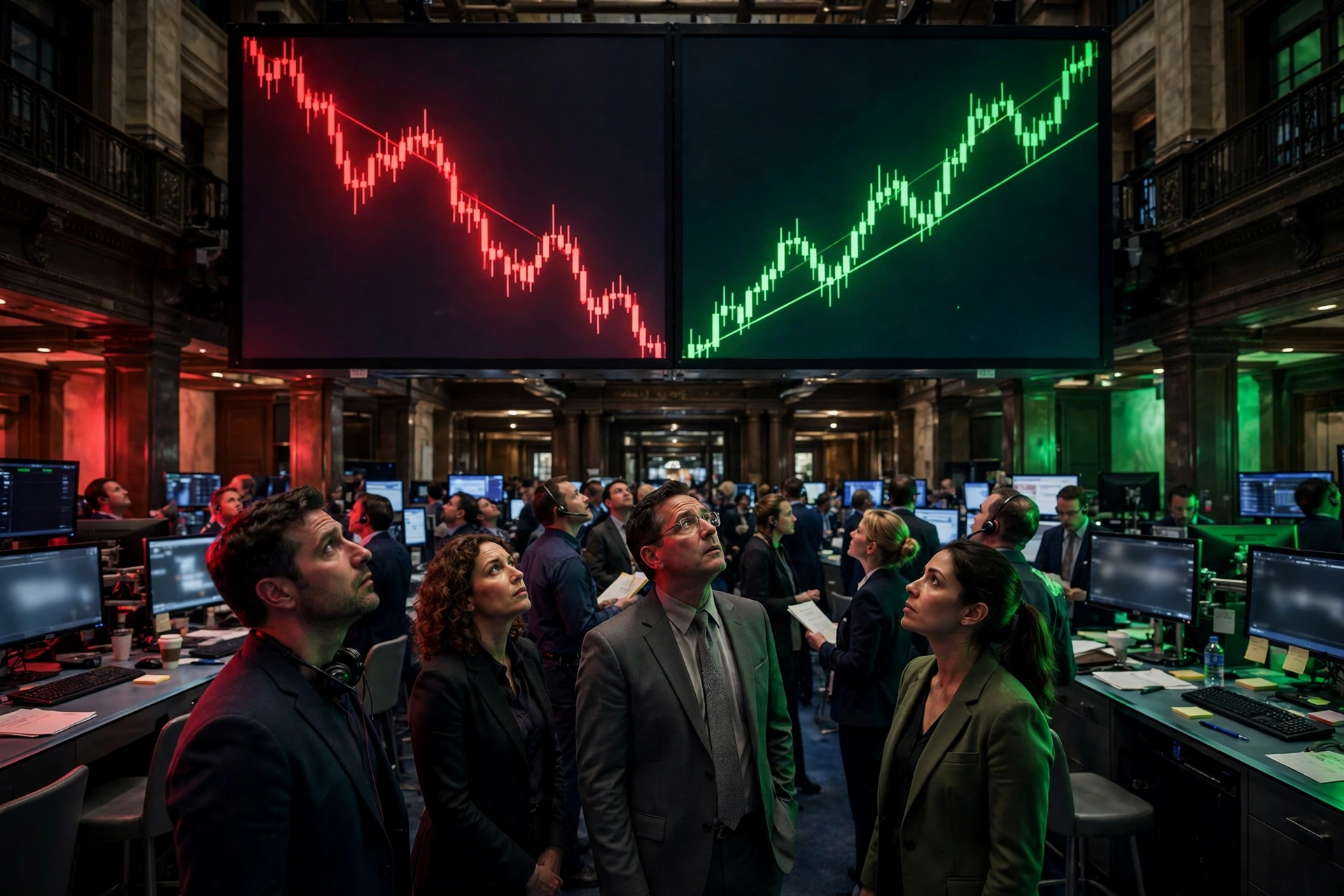
Wall Street had two of its wildest days of 2026 in a row, and both were about the same election. On Wednesday, 4 November, the Dow Jones Industrial Average posted its best day since April 2025 after Democrats swept the midterm elections and took control of both chambers of Congress. On Thursday, 5 November, the market gave it all back, and more, as investors sold the technology and chip stocks that power the artificial intelligence boom.
If you checked your retirement account on Wednesday night, you felt rich. If you checked it again on Thursday night, you felt poor. Neither feeling tells the full story. This article puts both days together, with the real closing numbers, the real reason for the reversal, and what history says usually happens after a midterm election.
This article is for information only and is not financial advice.
The Two Days in Numbers
- Wednesday, 4 November: the Dow rose 1,569.40 points, or 3.03 percent, to 53,356.12. The S&P 500 rose 119.70 points, or 1.58 percent, to 7,688.62. The Nasdaq Composite rose 364.50 points, or 1.44 percent, to 25,736.51.
- Thursday, 5 November: the Dow fell 1,833.06 points, or 3.44 percent, to 51,523.06. The S&P 500 fell 334.89 points, or 4.36 percent, to 7,353.73. The Nasdaq Composite fell 1,421.51 points, or 5.52 percent, to 24,315.00.
- Thursday was the worst day since April 2025 for all three major indexes. The Nasdaq closed in correction territory, 11.9 percent below its record close of 27,599.89 on 6 October.
- The Nasdaq 100 fell 6.4 percent on Thursday, erasing about 2.5 trillion dollars in market value in a single session, according to Reuters. Media tallies put the value erased from S&P 500 companies at close to 2.9 trillion dollars.
- Oil moved the other way. West Texas Intermediate crude fell 8.3 percent on Wednesday to 88.12 dollars a barrel, its lowest level in nearly two months, and the 10 year Treasury yield eased 5 basis points to 4.90 percent.
Wednesday: The Best Post-Midterm Day Since 1982
The rally on Wednesday was about certainty, not about any single policy. Election night ended with Democrats winning control of the House and the Senate, and with several key governorships, and that removed the biggest unknown hanging over the market. Investors also welcomed the shape of the result: a Democratic Congress facing a Republican White House, which is the divided government pattern Wall Street has often treated as a brake on sudden policy change.
The Dow surged 1,569 points, its biggest one-day gain after a midterm election since 1982, according to data from CFRA Research, and its best day since 9 April 2025, the day President Trump suspended his reciprocal tariffs. The S&P 500 had its second-biggest single-day post-midterm gain since 1982, and the Nasdaq had its biggest one-day post-midterm gain since 2018. Gains were led by Amazon, Microsoft and Apple, and the small company Russell 2000 rose 1.58 percent as well.
Cheaper oil helped the mood. Brent crude dropped more than 8 percent, and West Texas Intermediate settled at 88.12 dollars a barrel, down 7.97 dollars for the session. Lower oil prices ease inflation worries and leave households with more money to spend, and the market read the election result as a step toward calmer relations in the Middle East, which also pushed oil down. The new Congress is not seated until January, so nothing in the result changes any law yet, but the market priced the direction of travel on Wednesday.
Thursday: The AI Selloff That Erased It All
Thursday was a different market entirely. The Nasdaq fell 5.52 percent, its largest one-day percentage drop since the April 2025 tariff selloff, and the Philadelphia Semiconductor Index fell about 12 percent, its second-largest one-day fall on record. Nvidia dropped about 9 percent, AMD fell about 17 percent, Micron fell about 17 percent, SanDisk fell about 22 percent, and data centre operators Applied Digital, IREN and Nebius each fell more than 14 percent. CoreWeave fell around 10 percent, and Intel fell about 10 percent.
The damage was concentrated in the suppliers of the AI buildout, not in the companies that buy AI services. Chip and data centre stocks fell roughly two to four times as much as Meta, a major spender on AI infrastructure. The tech sector logged its worst weekly loss since the week ended 4 April 2025, and the Nasdaq ended the week down 3.4 percent. By the close on Thursday, the Dow had given back more than its entire 1,569 point gain from the day before.
The Nasdaq fell 5.52 percent on Thursday because investors suddenly repriced the political risk attached to the physical buildout of artificial intelligence, and the selling hit the chipmakers and data centre operators first.
Why Data Centres Flipped the Market
The trigger was not a company missing its numbers and not a change in interest rates. It was a reassessment of how fast data centres can be built, and on what terms, after the election result.
Several Democratic governors elected on Tuesday campaigned on slowing or pausing data centre construction, citing electricity consumption, water use and the effect on local communities. Texas, which is projected to host roughly 30 percent of United States compute capacity coming online through 2030, elected a Democrat, Gina Hinojosa, who has called for a moratorium on data centre development. Voters also weighed in directly: 41 ballot measures on data centre construction across 10 states were on the ballot, and 40 of them passed in favour of restricting or regulating the facilities. Of the 36 governors elected this time, 34 were found to support at least one form of data centre regulation.
The numbers behind the fear were specific. UBS analysts estimated that around 30 percent of expected United States data centre capacity additions in 2028 could face construction pauses. JonesTrading strategist Michael O’Rourke told Reuters the lasting theme of the election is the slowdown of the data centre buildout. Microsoft was reported to be letting an AI capacity deal with Oracle lapse and planning to reduce its neocloud partners, the smaller AI dedicated providers already under strain. A market that had priced years of uninterrupted AI infrastructure spending suddenly had to price delays, tougher permits and higher costs instead.
That is why the selling looked the way it did. The companies that build the chips, supply the power and operate the data centres fell hardest, while the big technology buyers fell less. The market moved, in the words of one fund manager quoted by The Guardian, from the promise of AI to the price of AI. None of this means any data centre law has changed yet. An expectation of tougher oversight is not the same as an enacted restriction, and the new Congress does not sit until January. But markets price expectations first, and Thursday was the price of a slower buildout.
What History Says Happens After Midterms
The two-day whipsaw looks dramatic, and it was, but the longer record after midterm elections is calmer than the headlines suggest. According to Edward Jones figures cited by CBS News, the S&P 500 averaged a 15.5 percent gain in the six months after the last 14 midterm elections since 1970. The pattern is not a guarantee, and every election is different, but it is the reason experienced investors treat the days right after a midterm as noise rather than a verdict.
There is a second reason for caution about reading too much into either day. Wednesday’s rally was driven by relief that the election was over, and Thursday’s selloff was driven by a single theme, the data centre buildout, that touches only part of the market. The Dow, which is weighted toward older industrial and consumer companies, fell 3.44 percent on Thursday. The Nasdaq, which is weighted toward technology, fell 5.52 percent. The gap between the two tells you the story was about AI infrastructure, not about the whole economy.
The next real test comes on 17 November, when Nvidia reports earnings. Its language on supply, power and customer timing will show whether orders are slipping or only the schedules. Until then, the market is trading on a political guess about data centres, not on reported results.
What This Means for Your 401(k)
For most people, the honest answer is that two days changed very little. A 401(k) is invested for decades, and its balance follows the index, not the daily news. On Wednesday the S&P 500 rose 1.58 percent, and on Thursday it fell 4.36 percent, so a typical stock heavy retirement account ended the two days down roughly 2.8 percent from where it started the week. That is a real loss of value, but it is the size of a normal bad week, not a retirement ending event.
Three practical points are worth keeping in mind. First, selling after a sharp fall locks in the loss and misses any recovery, and the historical record after midterms has favoured patience. Second, check your contribution, not your balance: the money going in every payday buys more shares when prices fall, which is the part of a 401(k) you actually control. Third, if your account is heavily weighted toward technology funds, Thursday hurt more than the index average, because the Nasdaq fell further than the S&P 500, and that is a question about diversification to raise with a qualified adviser, not a reason to act in a panic.
If you are close to retirement, the calculus is different, and a sharp week is a good reason to review your allocation with a professional. If you are decades away, the two days after the 2026 midterms are most likely a footnote. Either way, the right response to a whipsaw is a plan, not a trade made at midnight.
Frequently Asked Questions
Why did the stock market crash on 5 November 2026?
The Nasdaq fell 5.52 percent on 5 November because investors worried that Democratic midterm wins would slow the construction of AI data centres. UBS estimated about 30 percent of expected United States data centre capacity additions in 2028 could face construction pauses, and chip and data centre stocks fell hardest, with the semiconductor index down about 12 percent.
How much did the Dow rise after the midterm elections?
The Dow Jones Industrial Average rose 1,569.40 points, or 3.03 percent, to 53,356.12 on Wednesday, 4 November 2026. It was the Dow’s best day since April 2025 and its biggest post-midterm single-day gain since 1982, according to CFRA Research.
Is the Nasdaq in a correction?
Yes. After the 5.52 percent fall on 5 November, the Nasdaq Composite closed at 24,315.00, which is 11.9 percent below its record close of 27,599.89 on 6 October 2026. A fall of 10 percent or more from a record close is defined as a correction.
What is a data centre moratorium?
A data centre moratorium is a pause on building new data centres, usually imposed by a state or local government while it reviews rules on electricity use, water use and community impact. Several Democratic governors elected in the 2026 midterms campaigned for such pauses, and 40 of 41 local ballot measures on data centre construction passed in favour of restricting or regulating the facilities.
Does the stock market usually rise after midterm elections?
History says yes, on average. According to Edward Jones figures cited by CBS News, the S&P 500 averaged a 15.5 percent gain in the six months after the last 14 midterm elections since 1970. That is an average, not a promise, and individual years have varied widely.
Should I sell my 401(k) after a market crash?
Selling after a sharp fall locks in the loss and misses any recovery, and most retirement guidance says to review your allocation rather than sell in a panic. This article is information only and is not financial advice. If you are close to retirement, speak to a qualified financial adviser about your own situation.
About the Author

Chris Tzitzis
Chris Tzitzis has spent 10+ years explaining personal finance, taxes, investing, and crypto in plain language. Chris turns fine print into clear, verifiable steps, covering IRS relief programs, retirement contribution rules, and life and car insurance, so readers can check eligibility, limits, and costs for themselves. Chris’s guides focus on what is actually true, what applies, and where to verify it, rather than on promises or shortcuts.
More from Insight Bullion