
Hong Kong’s jewelry counters are having their best year since 2019. Sales of jewelry, watches, clocks and valuable gifts reached HK$45.8 billion (US$5.8 billion) in the first nine months of 2026, up 22% on the same period last year, according to Hong Kong government data reported by Bloomberg.
The surge stands out because almost everything around it is slowing down. Luxury spending in mainland China fell by more than 10% in the third quarter of 2026. Hong Kong’s jewelry sales kept growing at double-digit rates in the same quarter.
The buyers are not shopping for fashion. They are buying gold and gemstones to protect wealth that Beijing is now taxing harder.
The numbers behind the surge
The figures come from Hong Kong’s Census and Statistics Department, released on 3 November 2026. September alone tells the story: jewelry, watches, clocks and valuable gifts rose 20.3% year on year to HK$4.71 billion, the fastest growth of any retail category that month.
- Jewelry, watches and valuable gifts, Jan–Sep 2026: HK$45.8 billion, +22% year on year (Hong Kong government data, via Bloomberg)
- Jewelry sales, September 2026: HK$4.71 billion, +20.3% year on year (Census and Statistics Department)
- Jewelry share of all Hong Kong retail: about 15% (Bloomberg)
- Total Hong Kong retail, Jan–Sep 2026: +8.3% year on year (Census and Statistics Department)
- Total Hong Kong retail, September 2026: HK$33.4 billion, +6.4% year on year (Census and Statistics Department)
Total retail sales have now grown for 17 consecutive months. But jewelry is growing roughly three times faster than retail as a whole.
There is one number the headline hides. Adjusted for price changes, the volume of jewelry sales grew only 6.8% in the first nine months. The value jumped 22.4% because gold itself became much more expensive. People are spending far more money, but they are not buying far more pieces.
Why now: China’s 20% offshore trust tax
The trigger is a tax rule Beijing issued on 24 July 2026. Announcement No. 21, from China’s Ministry of Finance and the State Taxation Administration, imposes a 20% tax on offshore trust income, when assets go into a trust, on the trust’s income every year whether or not it is paid out, and when the trust is wound up.
Wealthy residents were given until 22 October 2026 to declare that income, with a 90-day grace period and no late fees. The rule also reaches back: unpaid tax on assets placed in trusts between 1 January 2023 and 31 December 2025 must be settled.
The scale is large. Boston Consulting Group estimates China’s offshore wealth at about US$1.7 trillion. Bloomberg identified eight Chinese billionaires holding listed shares through offshore trusts, with combined assets of about US$140.2 billion.
Enforcement is personal. China’s tax authority is working from the Hurun wealth rankings, corporate filings and other public information, and tax offices in wealthy provinces have set up dedicated task forces. Some teams are assigned to a single billionaire.
The response has been a rush to raise cash. Reuters reported on 16 October 2026 that some of China’s richest people are winding down offshore trusts, selling shares and even switching nationality. One example: an entity tied to Haidilao co-founder Shu Ping sold about 259 million shares in the hotpot chain on 8 September for roughly HK$2.75 billion.
The trust tax is part of a wider tightening. In recent months Beijing has restricted mainland firms from listing in Hong Kong, tightened controls on offshore stock trading and increased scrutiny of foreign trusts and insurance products.
Wealth preservation, not growth
The shopping in Hong Kong reflects a change in what wealthy Chinese buyers want. Growth and high returns are no longer the priority. Certainty is.
Hong Kong insurance agent Manna Wang told Bloomberg that her mainland clients used to ask her about high-return insurance policies. Now they ask her to take them shopping for gold jewelry. Her clients have spent up to US$15,000 per person, with China’s Laopu Gold among their favourite destinations.
“High returns are no longer the priority,” Wang said.
Alexis Bonhomme, chief executive of luxury consultancy Trinity Asia, put it the same way: “High jewellery and gold offer reassurance and longevity.”
The pattern is consistent across the luxury market. Wealthy clients are pulling back on seasonal fashion at home, Bonhomme said, but when they travel they are comfortable spending serious money on high jewelry and gold as tangible assets.
The brands feel it too. LVMH reported 8% organic growth in its jewelry and watches business in the first nine months of 2026, the fastest of all its divisions. At Kering, jewelry sales jumped 17% over the same period, while fashion and leather goods fell 2%.
Hong Kong has a price advantage as well. A strong yuan and the city’s tax-free status mean jewelry there can cost more than 5% less than on the mainland, according to Bloomberg’s reporting.
One thing buying gold does not do: it does not get around China’s tax or capital rules. Cross-border movements of money and assets remain subject to the law, and the trust tax applies whether the wealth sits in shares, insurance or a gold necklace.
Gold’s record year, and the catch
Gold itself has had a remarkable year. The World Gold Council’s Gold Demand Trends report for the third quarter of 2026, published on 3 November, puts the average gold price at US$4,262 per ounce in Q3, up 23% on a year earlier and the third-highest quarterly average on record. Gold climbed to a record high earlier in 2026 before retreating in recent months.
But the Council’s data carries a warning for anyone reading the Hong Kong numbers as a jewelry boom. Global jewelry demand actually fell 17% year on year to 313 tonnes in Q3, the weakest third quarter in the Council’s data series, because high prices are putting buyers off everywhere.
Hong Kong is the exception, not the rule. Its sales are rising in value because prices are high and because a specific group of buyers, wealthy mainlanders facing a tax bill, is choosing gold as a store of value.
The rest of the gold market tells the same story of caution. Central banks bought 321 tonnes in Q3, up 42% on a year earlier. Gold-backed ETFs added 211 tonnes. Bar and coin demand fell 19% as investors waited for a clearer price direction.
Tourism helps, but it is not the main driver
A tourism rebound is adding to the sales. Visitor arrivals to Hong Kong rose 12% in the first nine months of 2026 to about 40.7 million, with September up 22% year on year, according to the Hong Kong Tourism Board. Most visitors still come from the mainland.
Look closer, though, and tourism is a smaller part of the story than it seems. In August, overnight arrivals fell 3.7% while same-day arrivals surged 13.6%. That matters because an overnight visitor spends about HK$5,503 on average, against HK$1,139 for a same-day visitor.
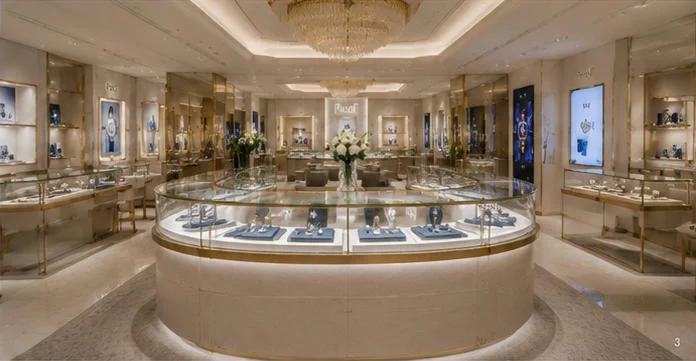
The brands are still betting on the city. Audemars Piguet is set to open one of its largest Asian flagship stores in Hong Kong. Italian goldsmith FOPE opened its first boutique in Greater China in Tsim Sha Tsui in October. Tiffany & Co opened a boutique with a cafe in Causeway Bay in May, and Van Cleef & Arpels relaunched its Central flagship in June after an expansion. Laopu has expanded its Hong Kong network further.
What it means for luxury fashion
Hong Kong’s jewelry surge is not a fashion trend. It is a wealth story wearing fashion’s clothes.
The buyers driving it are not following a season. They are responding to a tax deadline, a property downturn that has trapped household savings, a stock rally that has soured, and a gold price at record levels. Jewelry is the purchase that survives all four: it is portable, it holds value, and it can be worn.
That is why the category is outperforming every other part of the luxury market in Hong Kong, and why, as Bonhomme noted, the same clients cutting back on seasonal fashion at home are spending freely on high jewelry when they travel.
Whether the surge lasts depends on two things competitors are not tracking closely enough: whether Beijing’s tax enforcement keeps pushing wealthy residents toward tangible assets, and whether gold prices stay high enough to keep the value figures climbing while volumes stay flat. As of November 2026, both forces are still pointing the same way.
Frequently Asked Questions
Why are Hong Kong jewelry sales rising so fast?
Hong Kong jewelry, watches and valuable gifts sold HK$45.8 billion worth in the first nine months of 2026, up 22% on a year earlier and the highest for the period since 2019. The main driver is wealthy mainland Chinese buyers turning to gold and gemstones to preserve wealth as Beijing tightens tax on offshore assets. Higher gold prices and a tourism recovery also contribute.
What is China’s 20% offshore trust tax?
Announcement No. 21 of 2026, issued on 24 July 2026 by China’s Ministry of Finance and State Taxation Administration, taxes offshore trust income at 20%, when assets enter a trust, on annual trust income, and on wind-up. Residents had until 22 October 2026 to declare, with unpaid tax on trusts funded from 1 January 2023 to 31 December 2025 also due.
Is gold cheaper in Hong Kong than in mainland China?
Yes, by more than 5% in many cases, according to Bloomberg’s reporting. The gap comes from a strong yuan and Hong Kong’s tax-free status, which is one reason mainland buyers shop for gold jewelry there.
Is buying gold a way to avoid the tax?
No. Buying gold or jewelry does not circumvent China’s tax or capital controls. The 20% tax applies to offshore trust income regardless of what the money is later spent on, and cross-border asset movements remain subject to Chinese law.
Will Hong Kong jewelry sales keep rising?
That depends on two forces: continued tax enforcement pushing wealthy residents toward tangible assets, and gold prices staying high. The value of sales is rising much faster than the volume, up 22.4% in value against only 6.8% in volume, so the headline growth is heavily price-driven. If gold prices fall, the value figures will follow.
About the Author
Nicola Ebmeyer
Nicola Ebmeyer is a fashion and beauty writer with nine years in fashion and beauty editorial. Nicola specialises in skincare, aesthetics, and non-surgical treatments, interviewing dermatologists and cosmetic injectors and translating clinical detail into clear guides for first-time readers. Nicola also covers hair, styling, and dress codes, from everyday looks to black-tie events, with practical how-to advice readers can follow.
More from Insight Bullion