
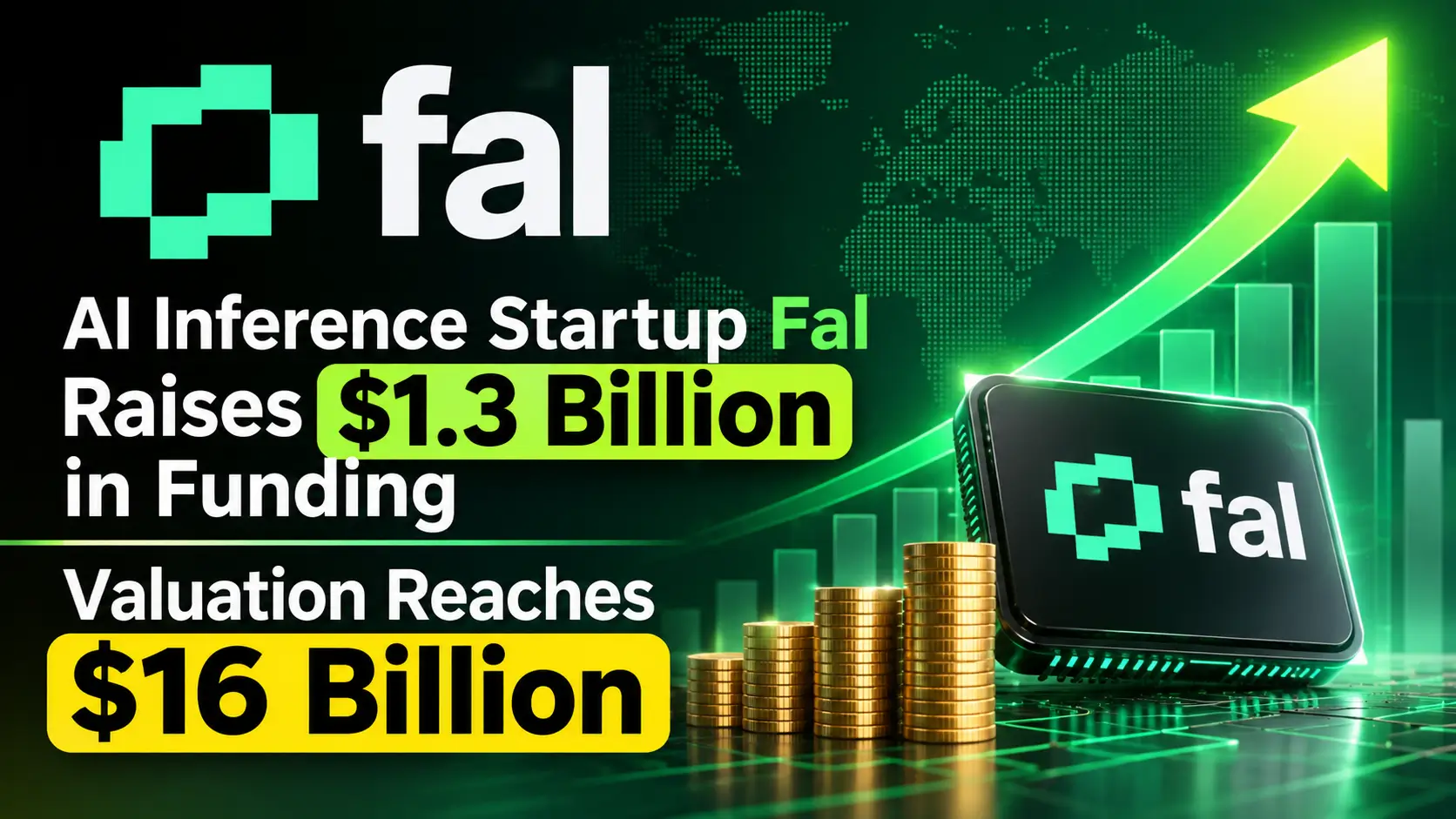
San Francisco-based AI inference startup Fal has raised $1.3 billion in a round led by Bessemer Venture Partners, doubling its valuation to $16 billion. The company hosts image, video and audio AI models for developers and creators. Its previous valuation was $8 billion in April 2026.
The deal is one of the largest private funding rounds in the AI infrastructure space this year. It also shows how quickly investors are repricing companies that run AI models in production. Here is who invested, why Fal needed so much capital, and what questions remain.
Fal’s $1.3 Billion Funding Round at a Glance
- Amount raised: $1.3 billion (Series F), per Bloomberg and TechCrunch
- Valuation: $16 billion, up from $8 billion in April 2026
- Lead investor: Bessemer Venture Partners, an existing investor
- Other investors: Nvidia, Sound Ventures, HOF Capital and T. Rowe Price
- Combined total: About $1.65 billion across the Series E and F rounds, announced together
- Timing: The round closed in October and was announced on Tuesday, November 3, 2026
- Board change: Bessemer partner Talia Goldberg is joining Fal’s board
The $1.65 billion figure adds the earlier $350 million Series E, led by Sequoia in April, to the new $1.3 billion Series F.
Who Invested in Fal’s Series F?
Bessemer Venture Partners led the round. It has backed Fal in earlier rounds, so this is a follow-on investment rather than a new bet.
Nvidia also participated, and it is a strategic investor as well as a financial one. Nvidia’s chips underpin the GPU infrastructure that companies like Fal rely on. Some analysts have asked whether chipmakers investing in their own customers makes AI funding look circular. That is an open debate rather than a settled conclusion.
Sound Ventures, HOF Capital and T. Rowe Price rounded out the investors named in reports.
Why Did Fal Raise So Much Money?
The short answer is computing power. Fal’s CEO and co-founder, Burkay Gur, told Bloomberg that demand grew so fast over the summer that the company had to rate limit customers because it could not serve everyone.
Gur said the company has already earmarked most of the round for compute. He described the plan as buying the capacity Fal knows it needs today, not building a cash cushion in case conditions change.
The rest will go toward growing the team, which currently stands at 185 people. Fal has also put more effort over the past year into post-training video models, working with both open-source and closed-source model makers. Some of those deals reportedly involve licensing fees or revenue sharing.
Gur said Fal does not plan to pre-train its own models in the short term, but did not rule it out for the future.
What Is Fal and What Does It Do?
Fal runs trained AI models on GPUs so developers and businesses can add AI features without managing their own servers. This work is called inference: running an already-trained model to generate outputs such as images, video or audio.
Developers access image, video, audio and 3D models through a single API. In October 2025, reports said the platform offered more than 600 models and counted customers like Adobe, Canva and Shopify. It also hosts the FLUX image models from Black Forest Labs.
A typical use case is an ad agency plugging a video model into its production pipeline to generate finished ads.
How Fal Started
Burkay Gur and Gorkem Yurtseven co-founded Fal in 2021. Gur previously led machine learning work at Coinbase, and Yurtseven was a developer at Amazon.
The company’s first product focused on data infrastructure. It pivoted after Stable Diffusion launched and began hosting an optimized version of that model. The founders have said inference revenue reached $1 million faster than they expected.
Fal’s Valuation History
Fal’s valuation has climbed fast. Based on reported figures, it grew by more than ten times between mid-2025 and October 2026.
| Round | Date | Lead investor | Valuation |
|---|---|---|---|
| Series B ($49M) | February 2025 | Bessemer | Not covered here |
| Series C ($125M) | July 2025 | Meritech | $1.5 billion |
| Series D | December 2025 | Sequoia | $4.5 billion |
| Series E ($350M) | April 2026 | Sequoia | $8 billion |
| Series F ($1.3B) | October 2026 (announced Nov. 3) | Bessemer | $16 billion |
Fal reportedly passed $800 million in annualized revenue earlier this year, according to a person familiar with the matter cited by Bloomberg. At that figure, a $16 billion valuation works out to roughly 20 times annualized revenue. Treat this as a rough estimate, since the revenue number is unconfirmed and dated “earlier this year.”
How Fal Compares With Other Inference Startups
Fal is not alone. Several inference providers are growing quickly and raising large rounds:
- Fireworks AI reportedly raised $1.5 billion in July at a $17.5 billion valuation, and has been reported to be eyeing a much higher valuation since.
- Baseten reportedly raised $1.5 billion in June and has been in talks for a larger round.
- Modal has also been reported to be in funding talks at a steep valuation.
One difference is focus. Fal concentrates on media generation (image, video and audio), while many rivals serve text-based models such as chatbots. Bessemer has argued that the two are technically different problems.
The Big Question: Margins
Demand looks strong. Profitability is less clear. According to TechCrunch, inference companies’ gross margins remain thin because buying or leasing GPU compute is expensive, based on people familiar with their financials.
That is why the timing of this round matters. If the new capital ends capacity shortages and margins improve, a high multiple becomes easier to justify. If margins stay thin, the valuation depends mostly on continued rapid growth.
Competition is a second factor. Large cloud providers are also building inference services, and they have far more resources than any startup. How defensible Fal’s position proves to be is still an open question.
What This Means for Developers and the AI Infrastructure Market
For developers, the round suggests that specialized inference platforms are becoming a real product category, not just a feature of larger clouds. Many teams prefer to call a hosted API over running their own GPU clusters.
More broadly, the deal reflects a shift in AI spending from training models to running them. Research firm MarketsandMarkets forecasts the AI inference market will grow from about $106 billion in 2025 to about $255 billion by 2030. Forecasts like this carry uncertainty, but they explain why investors are paying close attention.
This article is for general information only and is not investment advice. Valuations and revenue figures come from press reports and may change.
Frequently Asked Questions
How much did Fal raise?
Fal raised $1.3 billion in its Series F round, led by Bessemer Venture Partners. Together with its $350 million Series E from April, the company announced about $1.65 billion raised across the two rounds.
What is Fal’s valuation?
Fal is valued at $16 billion following the Series F round. That is double its $8 billion valuation from April 2026, according to Bloomberg and TechCrunch.
Who invested in Fal’s $1.3 billion round?
Bessemer Venture Partners led the round. Nvidia, Sound Ventures, HOF Capital and T. Rowe Price also participated. Bessemer partner Talia Goldberg is joining Fal’s board.
What does Fal do?
Fal is an AI inference startup that hosts image, video, audio and 3D models. Developers use its API to add AI features to their products without managing GPUs or servers themselves.
What is AI inference?
Inference is the process of running an AI model that has already been trained to produce outputs, such as generating an image or a video. Training builds the model, and inference is how it is used in real products.
How will Fal use the money?
Fal’s CEO said most of the funding is earmarked for computing power to meet demand. The company also plans to expand its 185-person team.
How much revenue does Fal make?
Fal reportedly reached $800 million in annualized revenue earlier in 2026, according to a person familiar with the matter cited by Bloomberg. The company has not published audited figures.
ABOUT THE AUTHOR

Katherine Kerpan is a business writer with 10+ years covering taxes, benefits, and consumer protection. Katherine checks business and money claims against primary sources, including IRS.gov, and covers markets, company news, and commodity prices, from stock comparisons and company filings to gold and copper pricing. Katherine’s work focuses on fact-checking business stories, separating verified figures from rumours, before readers make decisions on them.
More from Insight Bullion