
Norway has turned an insult into a tourism campaign, and the punchline is a public toilet. Visit Norway, the country’s official tourism board, is inviting travellers to visit the architect-designed loos along its 18 Norwegian Scenic Routes, and the page has drawn more than 80,000 views from over 170 countries in just five days. Today, 19 November, is World Toilet Day, which makes the timing perfect.
These are not novelty installations built for a joke. They are real rest stops, designed by some of Norway’s best-known architecture firms, set against fjords, beaches and mountain plateaus. Some have won international prizes. One is clad in gold. Here is the story behind the campaign and all 13 stops worth a detour.
How an Insult Became a Campaign
On 25 October 2026, at a campaign rally in Port Huron, Michigan, US President Donald Trump called Norway a “shithouse country”. He was complaining that the 2026 Nobel Peace Prize had gone to South African jurist Navi Pillay, announced on 9 October, instead of to him, and he said he did not want immigrants from Norway because he had not received the prize. Norway’s Foreign Minister, Espen Barth Eide, replied that the Norwegian Nobel Committee is independent and the government plays no part in choosing the winner.
Visit Norway answered with humour instead of diplomacy. It revived a page it had published years earlier about the country’s scenic public toilets, gave it the headline “Are these the world’s best shithouses?”, and promoted it on social media under the slogan “Norway makes shithouses great again!”
The joke worked. According to Skift, the toilet page drew more than 80,000 views from over 170 countries in five days, around 540 times its traffic the previous week, with roughly one in four visitors American. Fast Company reports the page has since passed 200,000 views, while related social media posts have generated 5 million organic views. Visit Norway spent less than $10,000 promoting it.
The campaign material was not made in a hurry. According to the Associated Press, it had been prepared several years earlier for World Toilet Day, which falls on 19 November. The insult simply gave Norway a reason to dust it off.
What the Norwegian Scenic Routes Are
The toilets sit along the Norwegian Scenic Routes, a network of 18 tourist roads where the Norwegian Public Roads Administration, known as Statens Vegvesen, has commissioned architects to design viewpoints, rest areas and public facilities that sit comfortably in the landscape. The idea is that architecture should enhance the drive, not just serve it.
All but one of the restrooms were designed by well-known or up-and-coming Norwegian architecture firms. The routes run through fjord country in the west, across mountain plateaus and up above the Arctic Circle in the north, so the same road trip can take in a glass platform over a fjord and a golden toilet on a white sand beach.
Thirteen Stops Worth a Detour
1. Stegastein, Sognefjord
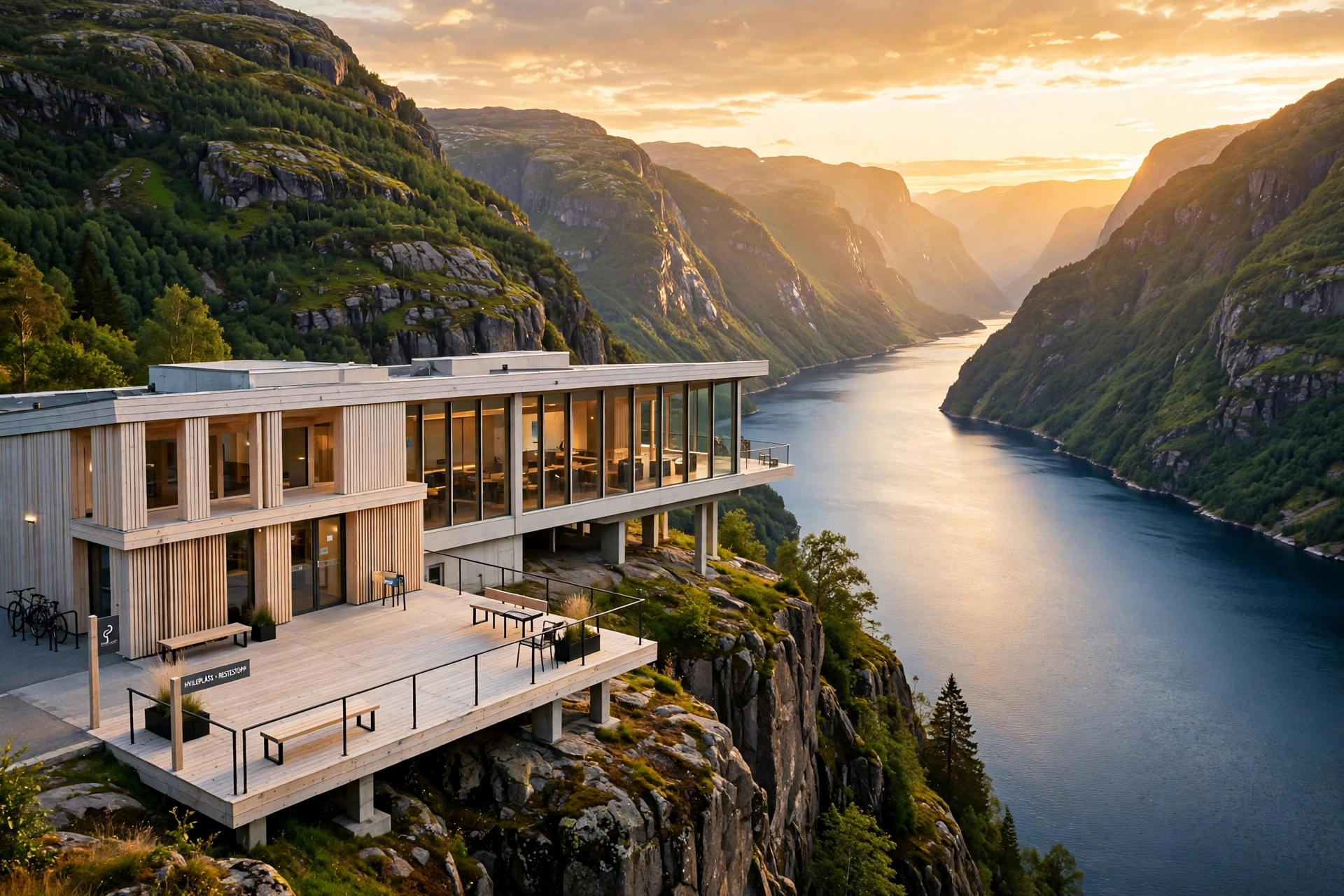
The most famous of them all. The restroom at the Stegastein viewpoint sits high above the Aurlandsfjord, next to a glass viewing platform that is open all year round. Design magazine DesignCurial counts it among the 10 best public toilets in the world, and The Telegraph called it what might be the most idyllic public convenience in the world. It was designed by architects Todd Saunders and Tommie Wilhelmsen and won a Norwegian National Construction Prize. The washroom itself is open from early May to late October.
2. Ureddplassen, Helgeland Coast
A wave-shaped building of poured concrete with frosted glass windows, fronting the fjord towards the open sea and the Lofoten Wall. It was designed by Haugen/Zohar Arkitekter and has been called the world’s most beautiful public loo. The nine-metre-wide terrace is a memorial place: a monument there honours those who died when the Norwegian submarine Uredd hit a mine in Fugløyfjorden during the Second World War.
3. Eggum, Lofoten
The restroom that comes with a piece of war history. It is built like an amphitheatre under the ruins of a German radar station, between mountains and the open ocean on Vestvågøy, a favourite spot for the midnight sun. It is the smallest design by the internationally acclaimed firm Snøhetta.
4. Ostasteidn, Ryfylke
High above the Sandsfjord, just after the Sandsfjord Bridge, stands an almost six-metre-tall concrete toilet designed by Kontor for Arkitektur og Plan. The architecture is inspired by the work of Norwegian painter Lars Hertervig, and the walls are designed so moss will start to grow on them, like camouflage. Benches nearby invite visitors to sit and take in the view.
5. Utsikten, Gaularfjellet
Some of the most majestic views on the Scenic Routes can be found at this rest area in the Sognefjord area. The toilet facilities, designed by Code arkitektur, are open from May to late October. The restroom here runs on solar power, so even the plumbing is part of the landscape story.
6. Tungeneset, Senja
At the outer edge of Senja, between Steinfjorden and Ersfjorden, a walkway of Siberian larch leads across the rocks towards the sea and the sharp peaks of the Oksen mountain. The facility was designed by Code arkitektur. Travel+Leisure Asia puts it bluntly: forget booking a tour to watch the northern lights, just head to this public toilet.
7. Madland Harbour, Jæren
Some toilets hide in the landscape. This one lights it up. On the weather-beaten coast of Jæren, the two toilets have a specially designed brick facade that makes the building glow in the dark like a lantern. It was designed by Haugen/Zohar Arkitekter.
8. Espenes, Hardanger
One of the most beautiful stops along Sørfjorden, on the road between Kinsarvik and Odda. The rest area, designed by Code arkitektur, is a 64-metre-long and 4-metre-wide steel structure with 12 roof modules of varying heights, under which the toilets and benches are placed, so visitors can enjoy the view while they wait.
9. Oscarshaug, Sognefjellet
With the iconic Mount Store Skagastølstind as its backdrop, this rest area has a royal history. It got its name because of a journey King Oscar II made over the mountain in 1860, and a cairn was built in memory of the trip. The loo itself had to be reinforced with a steel construction against the harsh weather, which gives it a look Visit Norway compares to a Viking helmet.
10. Flesefossen, Ryfylke
The largest rest area along National Road 13 between Sand and Røldal. The Flesefossen waterfall runs down the mountainside, and there are picnic spots close by for travellers who want to rest during their road trip while enjoying the views.
11. Hamningberg, Varanger
Hamningberg is also known as “the end of Europe”, a must-visit stop for people travelling between Norway and other European countries. Along with being a great place to experience the midnight sun, it lets visitors marvel at intact architecture from the 19th century.
12. The Golden Loo, Senja
On Ersfjordstranda beach on Senja, a white sand beach on one side and tall peaks on the other, stands a triangular toilet building clad in golden material. Designed by Tupelo Arkitektur and built in 2014, it is affectionately known as Gulldassen, the Golden Toilet. It is so popular that more low-key toilets are being built nearby, and a new silver-coloured service building opened at Ersfjordstranda in August 2026, creating an unusually glamorous pairing of roadside facilities.
13. Tyrvefjøra, Hardanger
Also known as the Fairytale toilet. This whimsical rest area in Ålvik along Hardangerfjord was designed by Helen and Hard: two separate toilets built of pine logs, under one big roof that looks like the top of a huge, overgrown mushroom and appears to float over the landscape.
How to Plan a Toilet Road Trip
A few practical points before you set off. Many of these stops are only reachable in summer, because some of the roads close in winter. Stegastein and Utsikten are both open from May to late October, and the same seasonal window applies to much of the network. Check that your stretch of route is open before you go, and remember that the weather can be harsh even in the open months.
They are public rest areas, so there is no ticket to buy. The cost is the drive itself, and the routes are designed to be driven slowly, with viewpoints and picnic spots built in along the way. A fjord road trip that strings together Stegastein, Utsikten, Espenes and Tyrvefjøra covers four of the best stops in a single region.
Visit Norway’s own advice is worth following: aim properly, flush when finished, and put paper towels in the bin, so the next visitor gets the same experience.
The Bottom Line
The campaign worked because the buildings were already there. Norway did not build a golden toilet to answer an insult; it had one on a beach in Senja since 2014, along with a dozen other architect-designed rest stops that tourists were already photographing. The joke only pointed the world at them.
There is also more to come. The Norwegian Public Roads Administration has started work on a forest-inspired restroom built from the dried wood of some 60 to 70 trees, shaped like an upside-down trunk with roots holding up the roof. When it opens, it will be one more reason to plan a road trip around Norway’s loos, whether you have to go or not.
Figures and quotes in this article come from the sources linked in the text: Travel+Leisure Asia, 9 November 2026, for the 13 stops, their descriptions, architects where named and opening seasons; Visit Norway for the Stegastein top 10 ranking, the Ureddplassen memorial, the Eggum amphitheatre, the Golden Loo’s popularity, the solar-powered Utsikten restroom, the Oscarshaug steel reinforcement, the 18 Scenic Routes and the forest restroom plan; Fast Company, 5 November 2026, for the campaign figures, the Stegastein architects and prize, and the Ureddplassen design; Travel Tomorrow, 2 November 2026, and Skift for the 80,000 views from more than 170 countries in five days; MyNewsDesk for the Ureddplassen, Tungeneset, Eggum, Espenes, Ostasteidn, Madland Harbour and Golden Loo architects and details; Travel Noire, 9 November 2026, for the Tyrvefjøra description; and Reuters, via the Press Democrat, Newspoint, NordiskPost and Clash Report, for the 25 October 2026 Port Huron remarks and the 9 October 2026 Nobel Peace Prize announcement.
Frequently Asked Questions
Why is Norway promoting its public toilets?
After US President Donald Trump called Norway a “shithouse country” at a rally in Port Huron, Michigan, on 25 October 2026, Visit Norway revived an existing page about the country’s scenic public toilets under the slogan “Norway makes shithouses great again!” The page drew more than 80,000 views from over 170 countries in five days.
What are the Norwegian Scenic Routes?
A network of 18 tourist roads where the Norwegian Public Roads Administration has commissioned architects to design viewpoints, rest areas and public toilets that fit into the landscape. The routes run through fjord country, across mountain plateaus and above the Arctic Circle.
Which is the most famous toilet in Norway?
The restroom at the Stegastein viewpoint above the Aurlandsfjord. Design magazine DesignCurial counts it among the 10 best public toilets in the world, and it was designed by Todd Saunders and Tommie Wilhelmsen.
What is the Golden Loo?
A triangular toilet building clad in golden material on Ersfjordstranda beach on the island of Senja, designed by Tupelo Arkitektur and built in 2014. It is so popular that more toilets are being built nearby, and a silver service building opened beside it in August 2026.
When can you visit Norway’s scenic toilets?
Many stops are open from May to late October only. Stegastein and Utsikten both follow that window, and some roads close in winter, so check that your stretch of route is open before travelling.
Do you have to pay to visit them?
No. They are public rest areas along the Scenic Routes, so visiting costs nothing beyond getting there. The routes are free to drive, with viewpoints and picnic spots built in along the way.
About the Author

Carlo Dibello is a travel writer who builds guides from trips actually taken and places personally tested. Carlo covers city guides, itineraries, food, and budget travel, comparing stays, transport, and attractions on the ground before recommending them, so readers get practical plans rather than generic lists. On Insight Bullion, Carlo’s work includes city things-to-do guides, seasonal trip ideas, and head-to-head travel comparisons.
More from Insight Bullion